4 September 2026
Audition First: Trash Crash vs China for Drummers

Audition First: Trash Crash vs China for Drummers
A trash crash is a crash-shaped hybrid built for short, controlled trashy accents. A China cymbal has an inverted edge and lip built for explosive, dirty punctuation and, in larger sizes, alternative ride work. If you need one accent that cuts cleanly and decays fast, get a trash crash. If you want raw volume, wash, and attitude, get a China.
TL;DR:
- Trash crashes produce sharp, quick decays suitable for controlled accents, while Chinas generate louder, washier explosions with longer sustain.
- Chinas typically sit lower, darker, and larger than trash crashes, which tend to stay higher and tighter across sizes.
- Larger Chinas over 18 inches can function as aggressive, dark alternative rides, especially in loud, live settings.
- To ensure proper sound and durability, check for factory-cut holes, flattened or reduced bells, and feel the edge for aftermarket modifications.
- Audition cymbals with various strikes and layered kit sounds to assess how they behave in actual playing conditions and in context.
Table of Contents
- Trash Crash vs China: How They Actually Sound
- What’s Actually Different Inside the Metal
- Does Size Change the Job Each Cymbal Does?
- Where Each One Actually Earns Its Spot
- How to Audition Before You Buy
- What a Distributor Sees Across Hundreds of Kits
- The Honest Take on Picking Between the Two
- Shop Trash Crash and China Cymbals at Temple of Sound
- Sources
Trash Crash vs China: How They Actually Sound
Hit a trash crash and you get a quick, controlled bark that’s gone almost as fast as it arrived. Hit a China and you get a broader, dirtier explosion with edges that keep buzzing long after the stick leaves the metal. That gap comes straight from how each cymbal is built, which the China cymbal entry describes as an inverted profile with a raw, aggressive bite that tends to run louder and washier than a comparable trash crash.
Pitch matters too. Chinas usually sit lower and darker, especially past 18 inches, while trash crashes stay higher and tighter, closer to a standard crash in register even though the decay is nothing alike.
Here’s how to tell them apart with your ears alone:
- Soft hit, trash crash: a short, papery click with almost no wash.
- Soft hit, China: a trashy sizzle that still hangs in the air.
- Hard hit, trash crash: a sharp bark that clears out within a second or two.
- Hard hit, China: a full explosion that keeps building and washing before it fades.
What’s Actually Different Inside the Metal
The sound comes from the shape. A China flips the outer edge downward instead of curving it up, which is why it produces that raw, gong-like crash instead of a clean one. A trash crash keeps a more familiar crash profile but gets drilled, cut, or reshaped to kill sustain fast. According to Ian Cory’s breakdown of modern cymbal design, perforations and cutouts reduce surface area and speed up decay, which is exactly the trashy, controlled snap that separates a good effects crash from a mediocre one.
Bell shape and taper matter just as much as the holes. The Zildjian FX 16" Trash Crash design shows how a flattened or squared bell, combined with a flatter taper, produces the hybrid feel manufacturers are chasing: crash-like playability with China-like grit.
- Look for visible holes or cutouts near the edge, a sign of intentional decay shortening.
- Check the bell. Flattened or reduced bells usually mean a faster, more controlled trash sound.
- Feel the weight. Thinner cymbals open up faster; thicker ones hold their bark longer.
Pro Tip: When shopping used, run your finger along the edge. Rough, uneven drilling from aftermarket modifications feels different from a factory-cut trash crash, and it usually plays differently too.
Does Size Change the Job Each Cymbal Does?
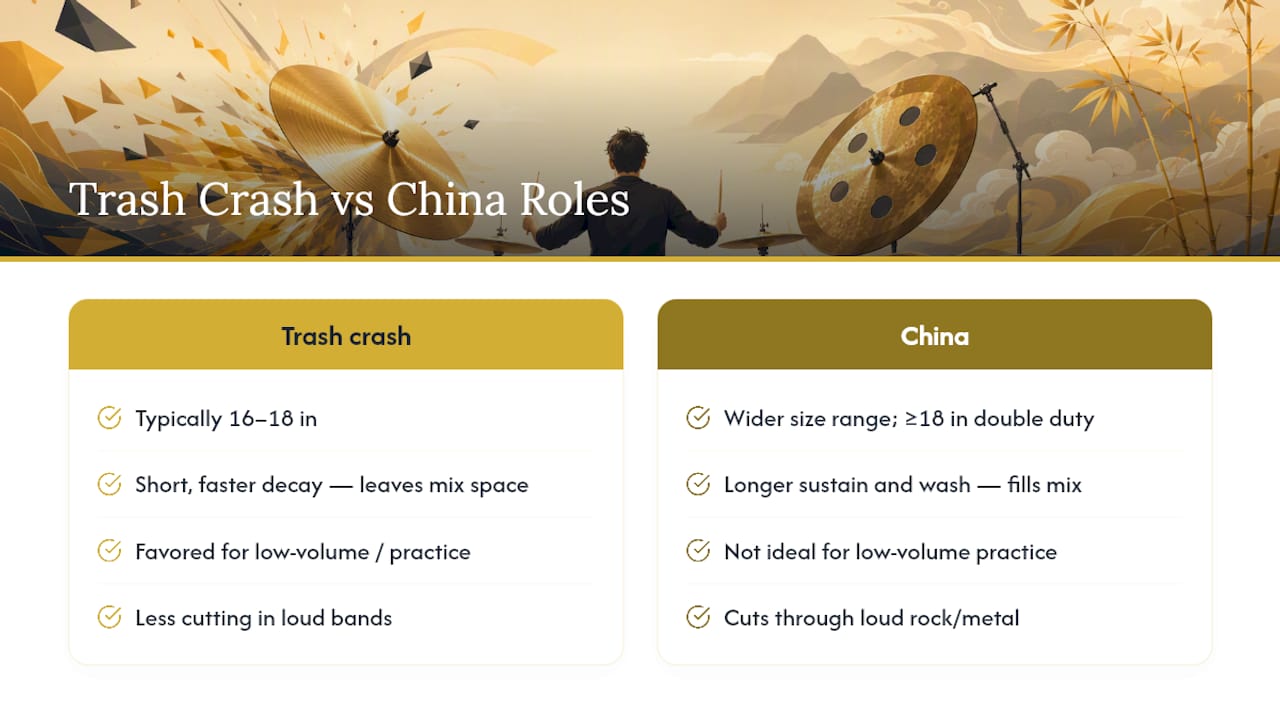
Most trash crashes run 16 to 18 inches, sized to work as a fast accent without overwhelming a kit. Chinas span a wider range, and once you get to 18 inches or larger, they start doing double duty. A big China can function as an alternative ride, giving you a dark, aggressive pattern voice instead of a traditional ride’s ping.
For studio work, smaller and shorter decaying cymbals usually leave more room in a mix, which is one reason engineers lean on trash crashes over big Chinas when space matters. For live rock or metal, a larger China’s volume and wash cut through a loud band better than a smaller trash crash ever will. Low volume or practice settings favor the trash crash almost every time, since it doesn’t flood the room with sustain.
Where Each One Actually Earns Its Spot
Genre and technique decide the winner here more than raw preference. In metal and hard rock, a China’s explosive punctuation works as a crash substitute on big accents or as an alternative ride under double bass patterns. In fusion and jazz, a trash crash gives you a controlled bark that doesn’t step on a busy arrangement the way a washy China would. In studio sessions across genres, engineers often reach for trash crashes specifically because the shorter decay leaves more space for other tracked instruments.
A few practical playing notes worth knowing before you buy:
- Mount a China at a steep angle and strike near the edge for the fullest wash; strike closer to the bell for a tighter, more controlled hit.
- Angle a trash crash the way you’d mount a standard crash, since it’s built to play like one despite the different voice.
- Try stacking a splash on top of either cymbal to add a shorter, higher-pitched attack without extra wash, a trick players discuss often on drummer forums as a way to control tone without buying a third cymbal.
How to Audition Before You Buy
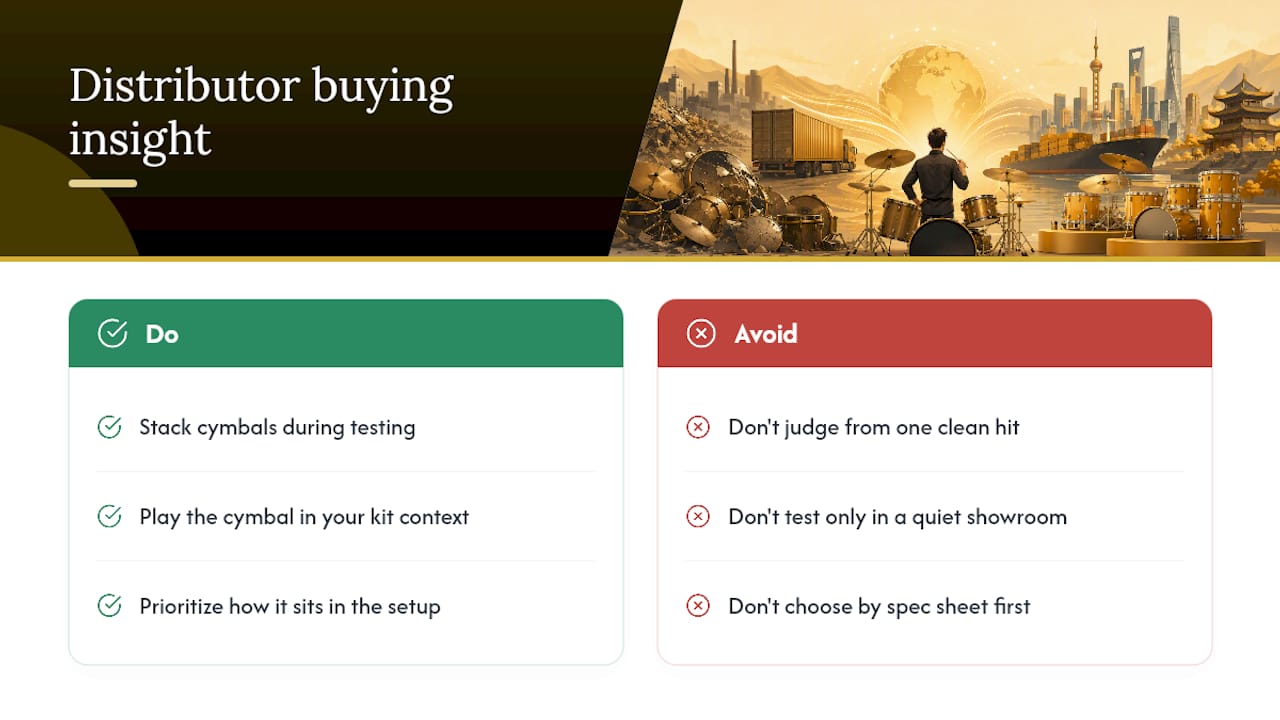
Never trust a single hit in a quiet room. Run each cymbal through soft, medium, and hard strikes, then hit it again while your ride and hi hats are still ringing, because a cymbal that sounds great alone can wash out the moment it’s layered into a full kit. If you can, record playback through a phone mic. Recordings expose harshness and wash that your ears filter out live.
- Ask the seller about weight (thin, medium, heavy) and finish (raw, brilliant, traditional), since both shift attack and decay noticeably.
- Test the cymbal stacked with a splash or another crash to see how it behaves in context, not isolation.
- Budget accordingly: cheaper traditional Chinese made Chinas can deliver extreme trash character affordably, but expect more variation piece to piece, while branded trash crash lines tend to play more consistently across the same model.
Pro Tip: If a shop lets you A/B two cymbals of the same model, do it. Even mass produced trash crashes can vary slightly in decay time, and five minutes of comparison saves a return later.
What a Distributor Sees Across Hundreds of Kits
Selling cymbals across various drum shops and direct to players reveals a pattern most single buyers never notice: the players who regret a purchase almost always skipped the stacked test and judged a cymbal by one clean hit in a quiet showroom. Matching a China or trash crash to an existing kit is less about the cymbal in isolation and more about how it sits against the rest of the setup, which is why our crash versus ride breakdown and ride cymbal size guide both push readers toward context first, spec sheet second.
The Honest Take on Picking Between the Two
Most drummers overthink this choice. Pick the trash crash if you want one clean, repeatable accent that won’t flood your mix. Pick the China if you want volume, grit, and a cymbal that can double as an alternative ride. Whichever you lean toward, audition it stacked and at the dynamics you’ll actually play, not just a polite tap in a quiet shop.
— Will
Shop Trash Crash and China Cymbals at Temple of Sound
This supplier offers an alternative to guessing blind online: they curate cymbal packs and offer direct guidance so you’re not choosing between a trash crash and a China based on a spec sheet alone.

Browsing our cymbal pack guide is a good starting point if you’re trying to figure out which effects cymbal actually fills the gap in your current setup, and our team can talk through your kit before you commit. Once you know what you’re after, head to the Temple of Sound shop to browse current stock, check trade account options if you’re buying for a shop, or reach out directly for advice matching a specific cymbal to your genre and volume needs.