27 November 2026
Stocking a Drum Shop: What to Carry and How Much
Stocking a Drum Shop: What to Carry and How Much
A drum shop is stocked well when fast-moving essentials never run out and a few distinctive lines give drummers a reason to walk in or order from you instead of a big-box site. That means sticks, heads and cymbals at the core, bought in small repeatable quantities, with one or two brands nobody else on the street carries. Below is the routine: what to put on the shelves, how to size each buy, how to display it, and how to decide what to reorder, discount or drop. We distribute London Drumstick Co. and Alchemist Cymbals in the UK and run trade accounts for retailers, so the sticks and cymbals sections are where we can be most specific.
TL;DR
- Build the core on consumables and cymbals: sticks and heads are the recurring “breakables” that bring customers back, and cymbals are where a shop earns its reputation.
- Buy only what you can sell within a set period, and favor small repeat orders over one big order chased for a discount.
- Display cymbals so players can hear them, group related items, and keep prices visible.
- Review turnover and gross margin return on inventory (GMROI) on a schedule, then remerchandise slow items before you discount them.
- Add one or two exclusive or distinctive lines so your shop is a destination, not just a stock list.
Table of Contents
- What a drum shop should carry
- Stocking sticks: depth beats breadth
- Stocking cymbals: let players hear them
- Choosing how much to buy
- Suppliers and trade accounts
- Organizing, displaying and signing the floor
- Deciding what to reorder, discount or drop
- Putting it together: a starter plan
- Stocking the Alchemist and London Drumstick lines
- Our view
- FAQ
- Sources
What a drum shop should carry
Start with what drummers wear out. In interviews with six local drum shops, sticks and drumheads came up as the things customers keep needing, and one owner described them as constant sellers. The same interviews mentioned used cymbals, a cymbal range running from budget to professional, dampening products and even specialty items such as soft brushes. The shops did not agree on a single top seller, which is the point: your own town decides.
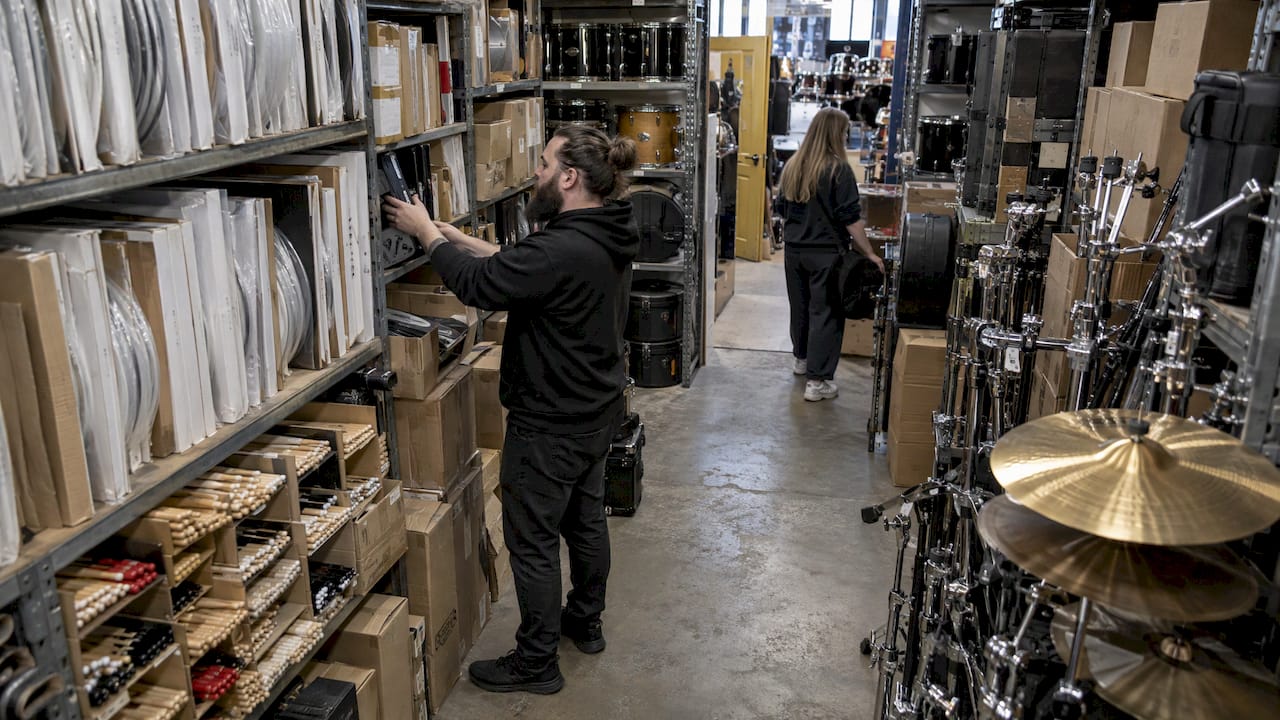
A full-line shop floor usually breaks down like this, as seen on the drum department of a large US music retailer: acoustic and electronic kits, snares, cymbals, hand and ethnic percussion, sticks and mallets, hardware, heads, parts and accessories, plus used and vintage instruments. You do not need all of that on day one. Sort it into three tiers.
Tier one: the replenishment core
Sticks, heads, tuning keys, dampening, cases and sticks bags. These are low-ticket, high-frequency items. A customer who buys a pair of sticks every few weeks is a customer who sees your shop every few weeks. Stock several sizes and tip shapes of sticks in depth, because a drummer who cannot find his model will not wait for it.
Tier two: the showpiece categories
Cymbals, snares and hardware carry the larger tickets. Cymbals deserve special attention because players want to hear them. In the same interviews, used cymbals sold well partly because customers could try them firsthand. That tells you how to merchandise new ones too, which we cover below.
Tier three: the destination lines
This is the product people travel for or search for by name. A 2010 Music Inc. retail feature argues that standard, faster-turning products and distinctive items do different jobs: the first meets dependable demand, the second can make a store a destination. Hand-hammered cymbals and a well-made stick line are natural candidates, because they give a drummer a reason to choose your shop.
Stocking sticks: depth beats breadth
Sticks are the easiest category to overstock in the wrong way. The temptation is to carry every model from every maker with one pair each. A better shelf has fewer models in real depth: the sizes drummers ask for most, plus a handful of specialty options.
London Drumstick Co. is one of the lines we distribute, and its range is listed on our drumsticks page. The company also offers custom drumsticks, which gives you something an ordinary rack cannot: a way to answer the player who wants a particular spec. If you want to understand how a spec is built, our spec-to-order checklist walks through it, and our guide to what custom sticks cost helps you explain pricing to customers.
For shops serving gigging players, it also helps to know what goes in a working bag. We cover that in our drumstick bag guide, and a pair-selection guide for small venues gives staff talking points when a customer asks what to buy for the room they play.
Stocking cymbals: let players hear them
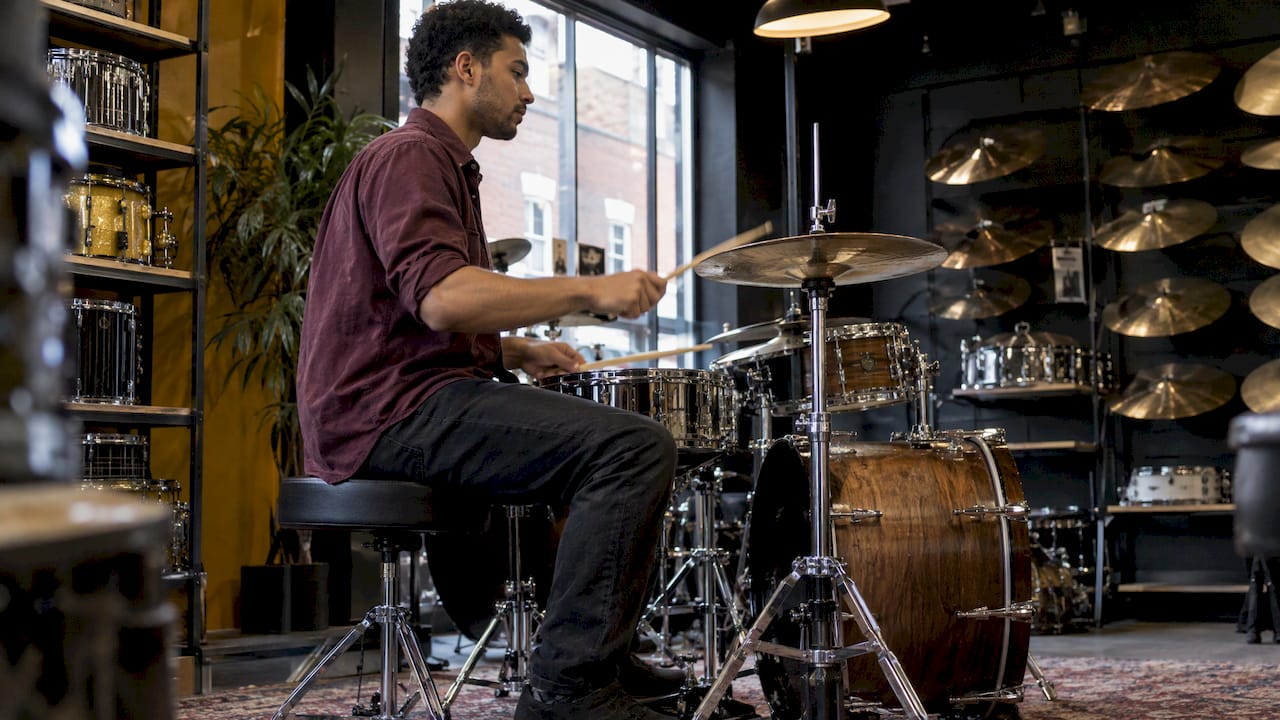
Cymbals are where a drum shop wins or loses. They are expensive, subjective and impossible to judge from a product photo. Two decisions matter: how many pairs and models to hold, and how you let customers audition them.
On range, cover the full spectrum. The six shops above reported a budget-to-professional cymbal range selling alongside used cymbals. A beginner needs a sensible first set; a professional wants character and handwork. Hand-hammered cymbals sit at the second end, and our Alchemist collection is built for that player. Retailers who want to see the current line can start from the B20 hand-hammered cymbal page.
On auditioning, a 2009 Music Inc. profile of Dale’s Drum Shop describes hi-hat pairs clamped on nearby stands so they can be tried straight away. The same profile says the shop moved products around every couple of weeks to give merchandise fresh exposure and dusted displayed gear regularly. Both habits cost almost nothing. For a deeper walk-through of layout, signage and demos, read our cymbal merchandising guide.
Choosing how much to buy
Product range is only half the job. The other half is how much of each thing to buy, with a fixed amount of floor space and cash.
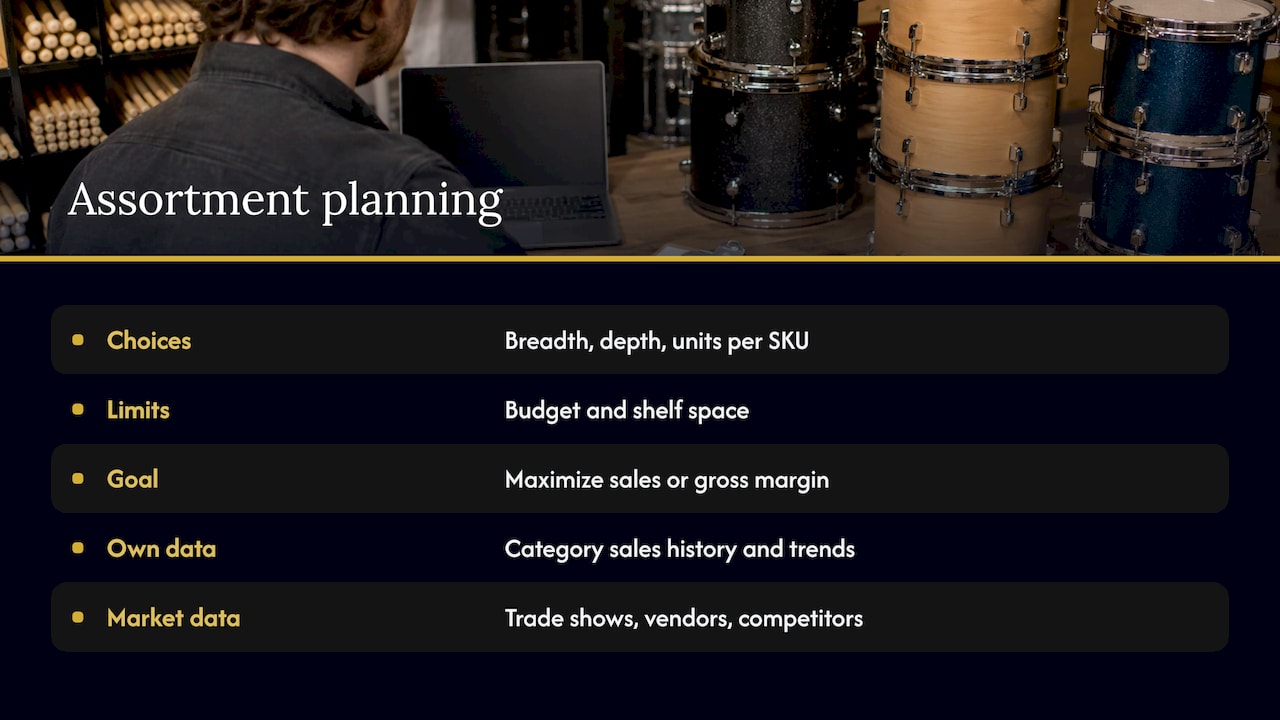
Retail researchers call this assortment planning. A Wharton and Duke review of the literature defines it as choosing products to maximize sales or gross margin within budget, shelf-space and other constraints. The inputs it points to are your own historical category sales and trends, plus information from trade shows, vendors and competitors. The trade-off is between breadth (how many different items), depth (how many SKUs per category) and units per SKU. A SKU is simply one distinct product variant, such as one stick model in one size.
NAMM’s four-question buying test
For each purchase, NAMM’s guide to smart inventory buys suggests asking four things:
- Do customers want it?
- Can you sell it at a profit?
- How quickly will it sell?
- How quickly must you pay the supplier?
It also recommends buying only quantities you can sell within your chosen period and considering small repeat purchases. A worked example: if you sell about eight pairs of a given stick model a month and want to cover two months, you buy sixteen, not forty because the price break starts at forty. NAMM’s financial IQ article warns that ordering just to reach a larger discount should not be a primary buying criterion, since it invites overbuying.
Think at the level of your own shop
A 2007 Inbound Logistics case study on Guitar Center stresses that chain-level averages can hide local shortages and excesses, and that inventory should be judged at store and SKU level because demand differs by location. For an independent that is good news: you already know that your town skews toward jazz, metal or school bands, and your range can lean that way.
Suppliers and trade accounts
Small repeat orders only work if your supplier makes them practical. When you compare suppliers, use the same four questions: how fast the product sells, what margin it leaves, how quickly you pay, and whether you can reorder in small quantities.
We sell to retailers through B2B trade accounts. Our guide on how to open a drum wholesale account takes you through the application, our wholesale requirements checklist lists what to have ready, and our wholesale percussion suppliers guide explains what to look for in any supplier relationship.
Organizing, displaying and signing the floor
A well-stocked shop that looks chaotic sells less than a modest shop that is easy to read. NAMM’s merchandising tips boil down to a handful of habits:
- Group related products together.
- Use vertical displays and keep merchandise between knee level and just above eye level.
- Put benefit-oriented signs and visible prices on everything.
- Limit confusing SKU choices for inexperienced customers.
- Package related items together to ease the decision and encourage add-on sales.
In drum terms: put sticks, a stick bag and a practice pad on one fixture; put heads next to tuning keys and dampening; put cymbal cleaning and cases beside the cymbal wall. A beginner who came for a pair of sticks leaves with a starter bundle.
Signage is a craft of its own. If you are fitting out a new shop or several, a retail signage rollout checklist is a useful way to plan wayfinding and point-of-sale displays so customers can browse without asking.
Tracking stock accurately
If you sell online as well as in the shop, accuracy matters more. NetSuite’s case study of Chicago Music Exchange describes assigning bin locations and scanning stock in and out, and using live visibility of stock on order and customer orders to allocate products across marketplaces and reduce overselling. Even a small shop can copy the principle: every item has a home, and every movement is recorded.
Deciding what to reorder, discount or drop
Stock decisions need numbers, reviewed on a schedule. NAMM’s inventory article names three measures:
| Measure | How NAMM defines it | What it tells you |
|---|---|---|
| Average inventory | (Beginning inventory + ending inventory) / 2 | The typical amount of cash sitting on your shelves |
| Inventory turnover | Cost of goods sold / average inventory | How quickly product sells |
| GMROI | Gross margin / average inventory cost | How much profit each inventory dollar earns |
Turnover shows speed; GMROI adds profitability. The financial IQ article notes that turns relate to cash tied up in aging or obsolete stock.
A simple monthly routine
- Pull a point-of-sale report of your top 20 SKUs by units and by dollars for each department.
- Keep those items in stock. They are your winners.
- List anything that has not sold in the past year.
- For slow sellers, try remerchandising and staff training first: move it to eye level, bundle it, teach staff to mention it.
- Only then discount or clear what still does not move.
A 2011 Music Inc. piece from former dealer Gerson Rosenbloom adds a useful frame: evaluate each department, category, brand and product, convert dead stock to cash, then refresh the range while keeping the lines that contribute materially to results.
Putting it together: a starter plan
For a new or small shop, a sensible order of operations is:
- Fill the core. Sticks in depth, heads, keys, dampening, bags.
- Add a cymbal wall with a good spread of price points and a place to play them.
- Choose one or two distinctive lines to be your destination products.
- Buy small and repeat. Measure for three months before increasing depth.
- Review monthly with your top 20 and no-turn lists.
Stocking the Alchemist and London Drumstick lines
If the plan above appeals, our trade accounts are the way to bring both lines onto your shelves: Alchemist Cymbals for the destination wall and London Drumstick Co. for the replenishment core. We are the exclusive UK distributor for both brands. For drummers buying for themselves, our memberships are on the same site: Free Member, Pro Member at £4.99 per month and VIP Member at £9.99 per month.

Browse the Alchemist collection or the London Drumstick Company range to see what your customers would find on the shelf.
Our view
We built Temple of Sound around a simple idea: high-quality percussion should be within reach of every drummer, from the beginner buying a first pair of sticks to the professional chasing a particular sound.
For a shop, that translates into a two-part range. Sticks are the product that keeps people coming through the door, and a stick line with real choice, including custom options, gives a retailer something to say yes to. Cymbals are where a shop becomes known, and handcrafted cymbals that players can hear on the floor are the kind of product that makes a customer remember where they bought them.
That is why we distribute London Drumstick Co. and Alchemist Cymbals together, and why we offer trade accounts alongside direct sales. Stock the dependable essentials, add something distinctive, and let the numbers tell you how deep to go.
Will
FAQ
What are the best-selling items in a drum shop?
Sticks and drumheads are the most consistent sellers, according to interviews with six local drum shops, which describe them as items customers keep needing. Used cymbals and a budget-to-professional cymbal range also sold well. Top sellers varied from shop to shop, so check your own point-of-sale data.
How much inventory should a new drum shop buy?
Buy only what you can sell in a chosen period, such as two months, and reorder in small quantities rather than one large order. NAMM’s buying guidance ties each purchase to customer demand, profit, speed of sale and supplier payment timing. Review after three months and adjust.
How do I know when to stop carrying a product?
List items with no sales in the past year and check turnover and GMROI for each category. NAMM suggests trying remerchandising and staff training before you discount or clear. If a product still does not move, convert it to cash and put the space toward a proven seller.
Can I open a trade account with Temple of Sound?
Yes, we offer B2B trade accounts for drum shops and retailers. Our guide on opening a drum wholesale account explains how the process works.
Sources
- Drum Study: Top Selling Products at Local Drum Shops (2025)
- Skip’s Music drum department
- Assortment Planning: Review of Literature and Industry Practice
- NAMM: How to Make Smart Inventory Buys
- NAMM: Will You Pass the Music Retail Financial IQ Test?
- NAMM: 10 Simple Merchandising Tips That Maximize In-Store Sales
- NAMM: Move Your Inventory by Choosing the Winners and Losing the Others
- Music Inc. (July 2010): 20 Music Retailers, Their Biggest Business Lessons
- Music Inc. (September 2009): Beat Big
- Music Inc. (January 2011): Boutique
- Inbound Logistics: Rock Around the Stock
- NetSuite: Chicago Music Exchange case study