19 September 2026
From $250: Temple of Sound's Drum Wholesale Checklist for Retailers

From $250: Temple of Sound’s Drum Wholesale Checklist for Retailers
Opening a drum wholesale account requires a resale certificate or VAT number, business registration matching your invoices, and enough working capital to cover a minimum opening order that often runs into the hundreds of dollars. Expect a manual credit review, prepayment until that credit is approved, and higher minimums for stock orders than for drop-ship setups. Approval isn’t automatic. Distributors turn down applicants over incomplete tax paperwork, a mismatched business model, or simply because another dealer already covers your zip code.
TL;DR:
- Most distributors require a current resale certificate or VAT number that exactly matches your business registration to avoid delays in approval.
- Approval for a wholesale account involves a manual credit review, and initial payment is typically prepayment or COD until creditworthiness is established.
- Discount tiers increase with higher purchase volume and ordering frequency, with larger, consolidated orders helping to reach better discounts faster.
- Application rejection often results from incomplete or mismatched tax documents, a business model perceived as reselling to other resellers, or proximity to an existing dealer in the same territory.
- Preparing all necessary paperwork and having a detailed, realistic business and purchase plan improves chances of approval and access to better terms.
Table of Contents
- Drum Wholesale Requirements Checklist for New Trade Accounts
- How to Qualify and Apply for a Dealer Account
- How Dealer Discount Tiers and Payment Terms Work
- Shipping, Drop-Ship Rules, and Return Policies
- Common Reasons Applications Get Denied
- Temple of Sound’s Perspective on Dealer Relationships
- How to Set Up Your Temple of Sound Trade Account
- Sources
- FAQ
Drum Wholesale Requirements Checklist for New Trade Accounts
Before you fill out a single application, pull together the paperwork distributors ask for on nearly every dealer intake form. Skipping one field is the single fastest way to get a “please resubmit” email instead of an account number.
- Resale certificate or VAT number. The name on it has to match your business registration exactly, right down to punctuation, because distributors cross-check invoices against it.
- Tax ID or federal employer identification. This is the field distributors use to validate that you’re a real, tax-registered business rather than a hobbyist buying at a discount.
- Proof of retail operation. A live website URL, storefront photos, posted business hours, and a handful of current product listings all show you’re operating a genuine retail channel, not reselling to other resellers.
- Trade references. Two distributor credit references are a common ask, and dealer application forms typically request business type, sales channels, and several business references before they’ll even schedule a review.
- Minimum opening order. Some dealer policies set opening-order minimums around $250 wholesale net, with separate, higher minimums for stock orders that unlock deeper discounts.
Every one of these documents needs to be current. An expired resale certificate or a business name that doesn’t match your bank account is enough to stall an otherwise clean application for weeks.
How to Qualify and Apply for a Dealer Account
Treat the application less like a form and more like a pitch. Distributors are deciding whether you represent their brand well, not just whether your paperwork is in order.
- Gather your documents first. Resale certificate, tax ID, business registration, storefront or website photos, and two or three trade references should all be ready before you open the application.
- Fill out the business description with specifics. Vague answers (“we sell instruments”) get less attention than a description naming your customer base, store format, and why your shop fits the brand.
- Pick your ordering model up front. Decide whether you’re a stocking dealer carrying inventory or a drop-ship account, and be ready to state a realistic annual purchase volume. Guessing high to look impressive backfires when your first year doesn’t match the number.
- Submit credit references or plan to prepay. New accounts commonly start on prepayment or COD until credit is approved, so budget cash flow accordingly rather than assuming net terms from day one.
- Track the timeline. Because distributor applications go through manual review rather than automatic approval, expect several business days to a couple of weeks before you hear back, longer if references need to be contacted.
If you’re denied, don’t argue the decision. Ask specifically what disqualified you, whether it was documentation, territory, or business model, and address that exact issue in a follow-up rather than resubmitting the same application unchanged.
How Dealer Discount Tiers and Payment Terms Work
Wholesale pricing on drums and cymbals isn’t one flat number. It moves in tiers tied to how much you buy and how often you order.
Some manufacturers structure this explicitly with lettered dealer classes. Santo Publications’ dealer program shows “A” dealers earning a substantial daily discount after hitting annual purchase thresholds or meeting order-frequency requirements, with lower tiers earning less until volume climbs. That’s a useful benchmark: expect your discount to grow with your track record, not with your first order.
Payment terms follow a similar logic:
- New accounts typically prepay or ship COD until a credit history is established.
- Approved accounts often move to net-30 invoicing once a few clean orders build trust.
- Stock orders carry higher minimums but come with better discounts and sometimes extended dating, letting you pay later in exchange for buying more upfront.
- Late payments can cost you your discount tier or your stock-order privileges entirely, sometimes reverting you to prepay status.
The practical lever here is consolidation. Combining accessory orders with instrument orders into fewer, larger purchases pushes you into higher discount bands faster than spreading the same dollar amount across smaller, frequent orders.
Shipping, Drop-Ship Rules, and Return Policies

Distributors generally sort dealers into two categories, and which one you fall into changes your minimums. Some dealer policies define non-stocking dealers by their drop-ship percentage, setting different order-ID handling and minimums for accounts that ship direct to customers versus those holding inventory.
A few things to confirm before you commit to either model:
- Stocking dealers usually need to place a set number of stock orders per year to keep their tier, not just hit a dollar total.
- Return authorization is required first. Shipping something back without an RA number is a common reason returns get refused at the dock.
- Restocking fees apply to non-defective returns, and return windows for defective claims are often as short as 30 days, so don’t sit on a warranty issue.
- Defective claims typically need photo evidence submitted with the RA request before a distributor issues a prepaid return label.
- Route returns to the correct distribution center, not the corporate office, or the package can bounce back to you unprocessed.
Get the RA process wrong once and you’ll understand why distributors are strict about it. It’s the difference between a smooth credit and a shipment sitting in limbo.
Common Reasons Applications Get Denied
Three issues cause most rejections: missing or mismatched tax documentation, a business model that looks like reselling to other resellers rather than end customers, and territory conflicts with an existing dealer nearby. Proximity to another approved dealer is one of the most commonly cited reasons for denial, so check this before signing a retail lease, not after.
Some terms are more negotiable than they first appear:
- Payment terms can often shift from COD to net-30 faster if you show sales projections and an existing customer base.
- Stock-order minimums sometimes flex for a limited introductory window.
- Minimum advertised price (MAP) policies are rarely negotiable, but distributors will explain enforcement clearly if you ask upfront.
Pro Tip: If a distributor hesitates on a full account, ask for a provisional or limited initial order instead of walking away. A smaller trial order that ships and sells well often does more to unlock a full dealer relationship than another round of paperwork.
Temple of Sound’s Perspective on Dealer Relationships
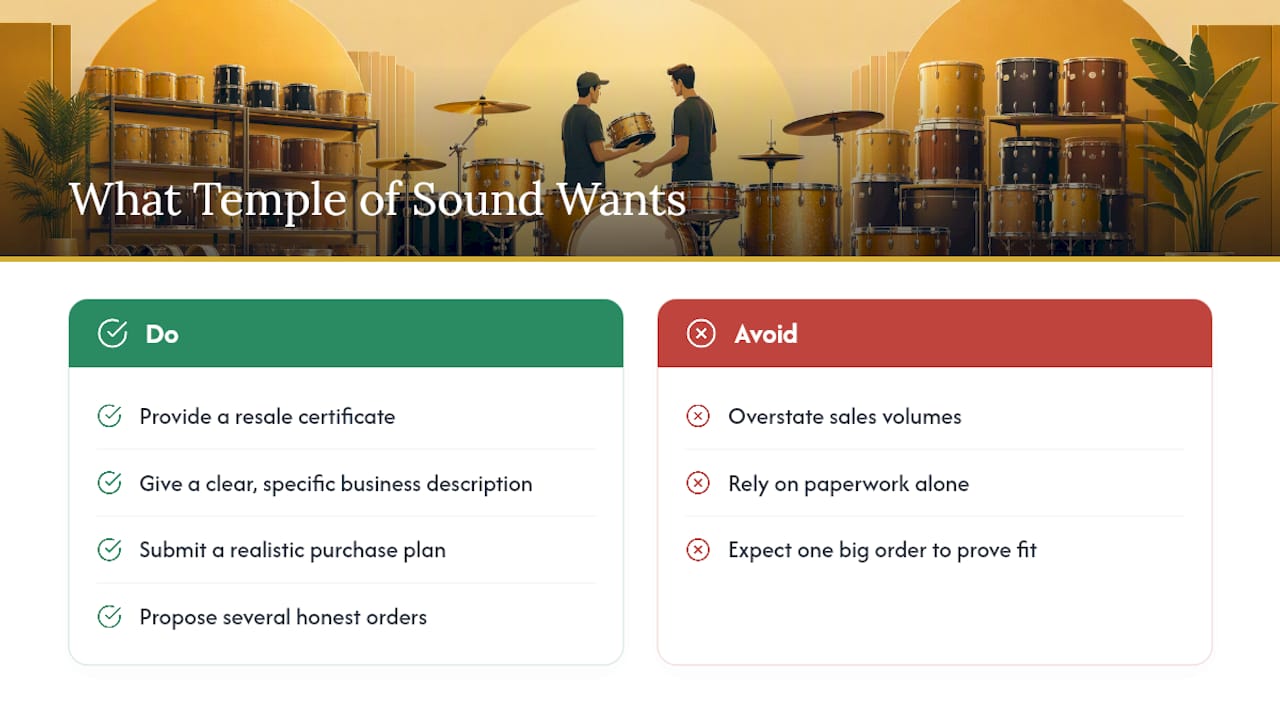
As the exclusive UK distributor for London Drumstick Company and Alchemist Cymbals, we look at dealer applications the way most credible distributors do: paperwork gets you in the door, but fit gets you the account. A resale certificate proves you’re legitimate. A clear, specific business description proves you understand the brands you’d be representing.
What stands out in a strong application is realism, not size. A shop with a modest but well thought out purchase plan reads better to us than an inflated volume estimate with no history behind it. We’d rather build a relationship over several honest orders than approve one oversized account that stalls in month two.
— Will
How to Set Up Your Temple of Sound Trade Account
If you’re preparing to apply, the fastest path is having your resale certificate, tax ID, business registration, and a couple of trade references ready before you start, exactly the same documents distributors across the industry ask for. Our own walkthrough, How to Set Up a Temple of Sound Drum Shop Account, covers the exact fields you’ll fill in and what we look for in each one.

Beyond the trade account itself, Temple of Sound runs three membership tiers that shape your pricing and perks: Free Member, Pro Member at £4.99 per month, and VIP Member at £9.99 per month. Higher tiers layer in trade-relevant discounts and early access to new runs from the Alchemist Collection and London Drumstick Company lines, on top of whatever dealer pricing your account earns. If you’re ready to move forward, submit your dealer application through Templeofsound and our trade support team will confirm your documents and walk you through first-order minimums directly.
Sources
For the underlying policy language referenced throughout this guide, consult the ALFRED MUSIC Dealer Discount Policy for discount schedules and return terms, the Santo Publications dealers resource page for dealer-class structures, and the International Music Co. dealer application for a sample of required fields.
- ALFRED MUSIC Dealer Discount Policy (dealer resource PDF)
- Santo Publications dealers resource page
- Cardinal Percussion dealer information
- International Music Co. dealer application
FAQ
What documents do I need to open a drum wholesale account?
You’ll need a resale certificate or VAT number, a tax ID, proof of business registration, and evidence of an active retail operation such as a website or storefront. Most dealer application forms also request two or three trade references before approval.
What is a typical minimum opening order for drum distributors?
Minimums vary by distributor, but some published dealer policies set an opening order around $250 wholesale net, with stock orders requiring a higher minimum in exchange for a bigger discount. Always confirm the current figure directly with the distributor before ordering.
Why do distributors deny wholesale applications?
The most common reasons are incomplete tax or resale documentation, a business model that looks like reselling to other resellers, and proximity to an already approved dealer in the same territory. Fixing the specific issue cited and reapplying is usually more effective than resubmitting unchanged.
How does Temple of Sound’s membership affect wholesale pricing?
Temple of Sound offers Free Member, Pro Member (£4.99/month), and VIP Member (£9.99/month) tiers, which layer discounts and early access on top of your standard trade account terms. Details and sign-up are available at Templeofsound.
Can I negotiate payment terms with a drum distributor?
Some terms move, particularly the shift from COD to net-30, if you can show sales projections and an existing customer base. Stock-order minimums occasionally flex for a limited trial period, though MAP pricing policies are rarely up for discussion.