9 September 2026
Drummers: 2.25" vs 3" Benchmarks and a 4 Step Drumstick Taper Test
Drummers: 2.25" vs 3" Benchmarks and a 4 Step Drumstick Taper Test
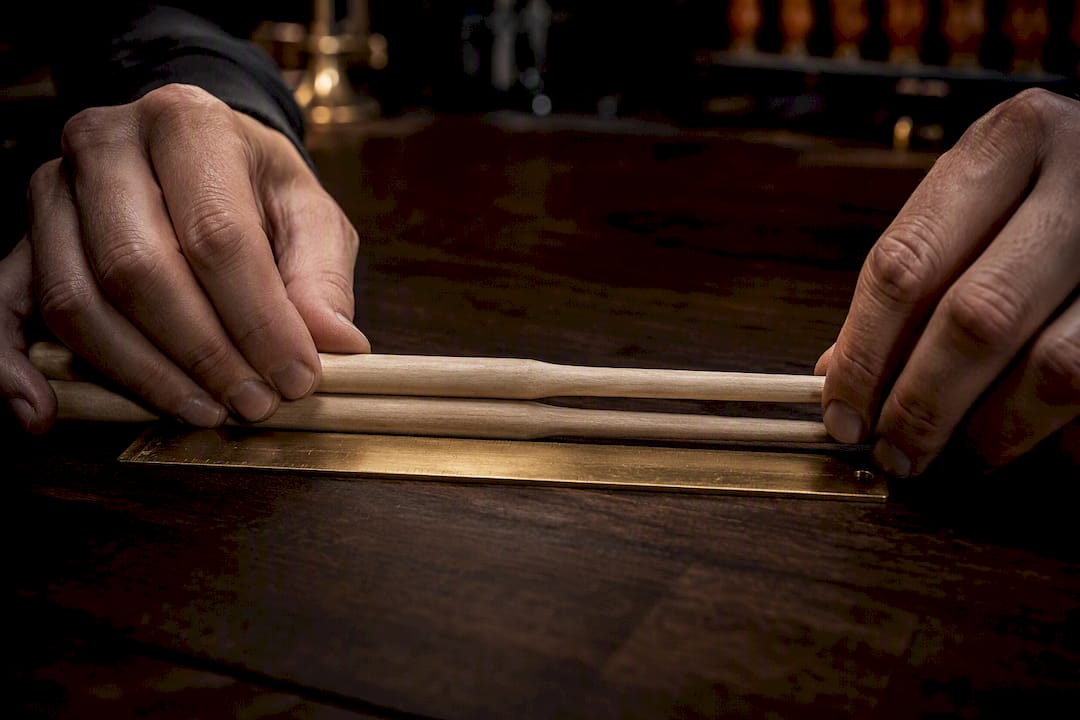
Taper is the narrowing section of a drumstick between the thick shaft and the tip, and it decides more about how a stick feels than weight or wood ever will. A long taper, often several inches on rebound-focused sticks, shifts the balance toward your hand and gives you a lighter, faster bounce. A short taper, somewhat shorter, keeps mass near the tip for power and durability. Neither is “correct.” The right one depends on your grip, your genre, and how your wrist reacts to flex versus stiffness.
TL;DR:
- A taper length of 3 inches provides a lighter feel and faster rebound, ideal for jazz and light pop playing styles.
- Short tapers of around 2.25 inches offer a front-heavy balance that enhances durability and power for rock and metal genres.
- Long tapers shift the balance point toward the hand, causing players to grip farther back and experience a more effortless rebound.
- Taper profile and length influence stick response more than diameter alone, making testing feel crucial for proper fit.
- Matching stick weight within 1 to 2 grams and testing on a practice pad or cymbal ensures optimal comfort and performance.
Table of Contents
- What Is Drumstick Taper and Where Is It Measured?
- Long Taper vs Short Taper: Balance, Rebound, and Tone
- Which Taper Fits Your Genre and Playing Style
- How Taper Changes Your Grip and Reach
- Durability and Breakage: Where Tapers Fail First
- How to Test and Choose the Right Taper
- Matching Taper to Weight: A Templeofsound Perspective
- Find Your Taper, Then Build Around It
- Sources
What Is Drumstick Taper and Where Is It Measured?
Taper is the section of the stick that narrows from the shoulder (the widest part of the shaft) down to the tip. It’s not the whole stick length, just that transition zone, and its shape determines how the wood flexes under load.
Manufacturers describe two things when they talk taper: length and profile. Magazine](https://drummagazine.com/how-to-shape-your-sound-with-drumsticks/). Taper profile is how abruptly that narrowing happens, with either a gradual curve or a quick, aggressive cut.
- Taper length determines where the balance point sits and how much flex the stick has.
- Taper profile determines how sudden the transition from full diameter to tip feels in the hand.
- Shoulder position interacts with both, since a taper that starts farther from the tip behaves differently than one that starts close to it.
Two sticks can share identical diameter and overall length and still play nothing alike once taper changes, which is exactly why Mixdown’s drumstick guide calls taper one of the most overlooked spec numbers on the box.
Long Taper vs Short Taper: Balance, Rebound, and Tone
A long taper moves the balance point rearward, toward your hand, and that shift changes everything downstream. Less wood mass near the tip means less resistance when the stick meets a drumhead or cymbal, so it springs back faster with less effort from your wrist. DRUM! Magazine points to 3 inch tapers as a common spec on rebound-oriented models built for exactly this feel.
A short taper keeps more wood near the tip. That front-heavy distribution resists flex, which trades speed for stopping power. Forward-balance sticks built around a 2.25 inch taper hit harder per stroke and hold up better under repeated impact, the same source notes.
The trade-off in numbers:
- Around 3 inches of taper: lighter tip feel, faster rebound, more flex through the shaft.
- Around 2.25 inches of taper: front-heavy feel, stiffer response, more durability and projection.
Wood species and diameter modulate both effects. A hickory stick with a long taper flexes more than a maple stick with the same taper, since maple runs lighter and less rigid by nature. Tip shape matters too. DRUM! Magazine’s guide to choosing drumsticks notes that a round tip on a long-taper stick articulates differently than a teardrop tip on the same taper, so the two variables should always be judged together, never in isolation.
Which Taper Fits Your Genre and Playing Style
Genre doesn’t dictate taper by rule, but certain tapers make certain jobs a lot easier.
- Jazz and light pop benefit from long tapers. The extra rebound supports quick cymbal work, ghost notes, and the kind of finesse playing where you’re barely touching the head.
- Rock and metal lean toward short tapers. You need the mass up front to punch through a mix and survive backbeats that would splinter a lighter-balanced stick.
- Versatile gigging players often land on medium tapers, a middle ground that doesn’t excel at either extreme but doesn’t fail at either one either.
- Studio work varies by session, but engineers often prefer long-taper sticks for their controlled decay and cleaner articulation on overheads.
Signature models exist partly to shortcut this decision. When a pro’s name is stamped on a stick, the taper spec is usually the real story, not the diameter. A signature stick often uses a nonstandard taper to land “in between” the stock forward and rebound balances, giving players a shorthand for a feel that would otherwise take real trial and error to find.
How Taper Changes Your Grip and Reach
Taper doesn’t just change what happens at the tip. It changes where your hand naturally wants to sit on the stick.
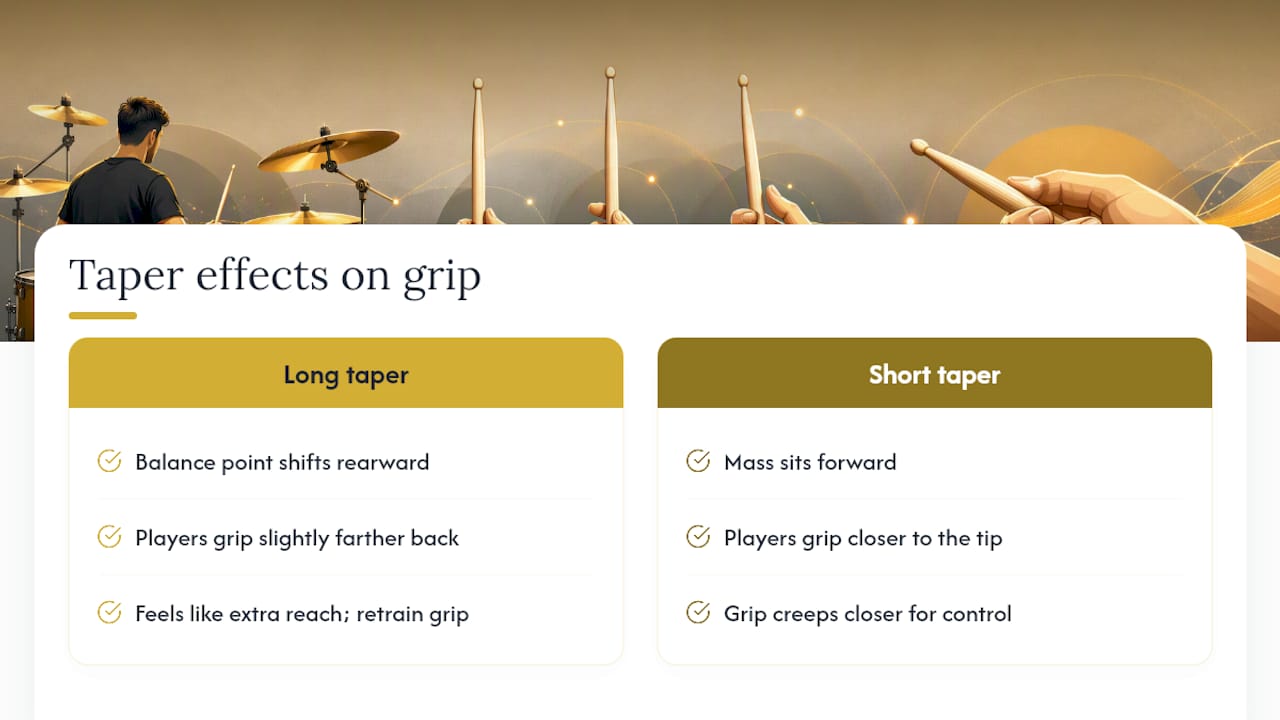
A long taper pulls the balance point back, and most players respond by gripping slightly farther back too, according to DRUM! Magazine’s breakdown of stick balance. That shift can feel like extra reach even though the stick’s total length hasn’t changed. A short taper does the opposite. With the mass sitting forward, many players instinctively creep their grip closer to the tip to keep control.
If you’re switching from a short taper to a long one, expect a short adjustment period. Play a few grooves at a slower tempo and pay attention to where your fulcrum naturally wants to sit. Small grip retraining, rather than fighting the new balance, gets you comfortable faster than forcing your old hand position onto a stick built for a different one.
Durability and Breakage: Where Tapers Fail First
Sticks almost never snap in the middle of the shaft. They break at or just past the shoulder, right where the taper begins to narrow, since that’s the thinnest cross-section under the most repeated stress.
Short tapers generally hold up better for hard hitters because the neck stays thicker for longer before it narrows toward the tip. Long tapers, with their extended, gradual thinning, flex more and take on more fatigue over a set, which is part of why they favor lighter players over drummers who dig in hard.
A few habits extend stick life regardless of taper: rotate sticks between sets so wear doesn’t concentrate on one pair, check for hairline cracks near the shoulder before every gig, and retire a stick the moment you feel a dead spot or hear a duller tone than its partner. Our drumstick maintenance guide covers the full checklist.
How to Test and Choose the Right Taper
Specs on a box only tell you part of the story. Drumming and Upbeat Studio both make the same point: there’s no universally right taper, so you test by feel, not by label.
- Measure balance point and compare taper length. Hold the stick horizontally on one finger and note where it balances. Compare that against the manufacturer’s stated taper (2.25 inches versus 3 inches, for instance) to see whether the spec matches the feel you expect.
- Run a rebound test on a practice pad. Drop the stick from the same height each time and watch how fast and how high it bounces back. A long taper should feel almost effortless; a short taper will take more wrist work.
- Test on a cymbal. Play the same pattern at a few different angles and listen for articulation and stick definition. Taper and tip shape together decide whether you get a clean attack or a washy blur.
- Play a 10 to 15 minute groove and track fatigue. Specs feel fine for the first thirty seconds. The real test is whether your forearm still feels loose fifteen minutes in.
Pro Tip: Bring a small ruler when you’re shopping in person. Measure the actual taper length on the stick you’re holding and compare it against the 2.25 inch and 3 inch benchmarks. Printed specs and the actual stick in the bin don’t always match.
Matching Taper to Weight: A Templeofsound Perspective
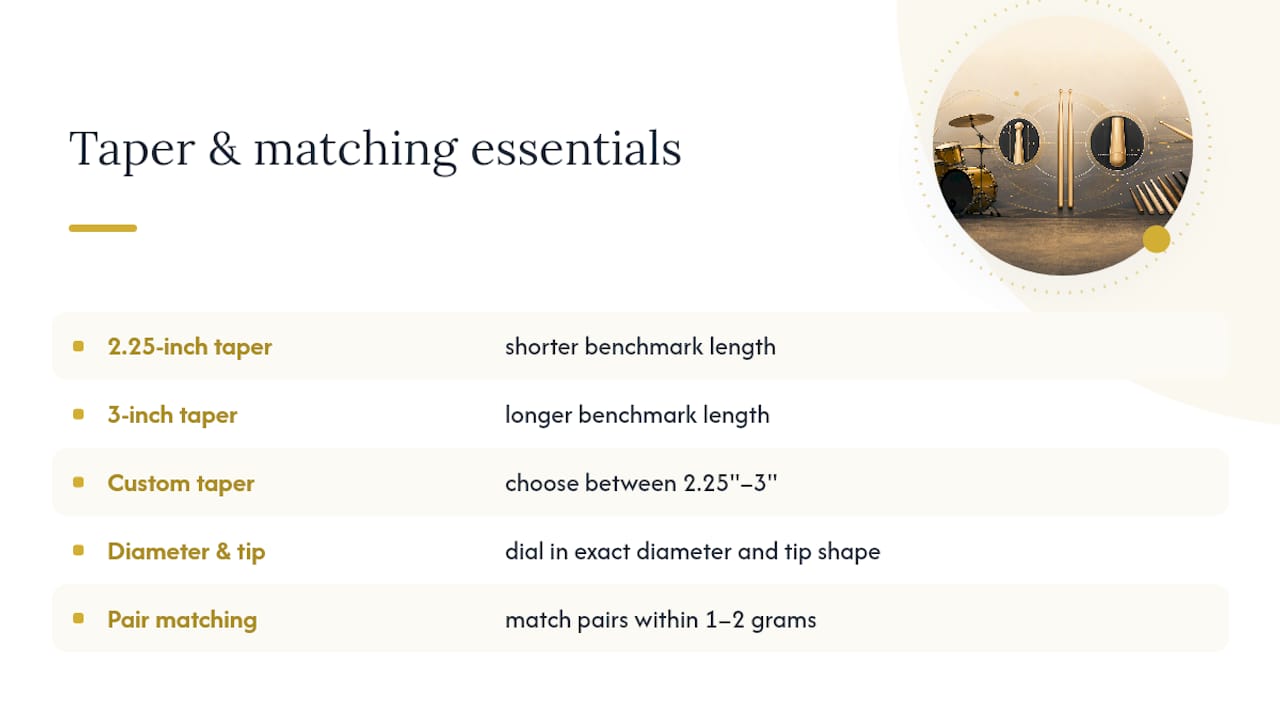
Taper rarely works alone. Weight matters just as much, and matching stick pairs within 1 to 2 grams of each other can help avoid the subtle fatigue that comes from playing slightly mismatched sticks over a full set, a detail covered in our drumstick weight matching guide.
If neither a stock forward-balance nor a stock rebound-balance stick feels right, a custom taper is the next move. Spec-to-order sticks let you dial in a taper length between the standard 2.25 inch and 3 inch benchmarks, paired with the exact diameter and tip shape you want. Our custom drumsticks guide walks through how to specify that build, and the design checklist is worth a look before you place an order.
Find Your Taper, Then Build Around It
If you play mostly jazz or light pop, start your search with long-taper sticks in the 3 inch range and see how the extra rebound feels under your wrist. If you’re hitting hard in a rock or metal context, start short, around 2.25 inches, and prioritize the durability that front-heavy balance gives you. Everyone else should try a medium taper first and adjust from there based on what the fatigue test tells you.
Two next steps matter more than brand loyalty. Run the four-step try-on checklist above on at least three different sticks before you commit to a pair, and if none of them feel quite right, consider custom taper specs instead of settling. Sticks are cheap enough, and the difference between a taper that fits your hand and one that doesn’t is not subtle once you know what to feel for.
— Will
Sources
- How To Shape Your Sound With Drumsticks - DRUM! Magazine
- The student’s guide to drum stick sizes and how to choose them - Upbeat Studio
- Drumming
- A guide to drumsticks - Mixdown