27 August 2026
Avoid Fatigue During a Set: Match Drumstick Weight to 1–2g
Avoid Fatigue During a Set: Match Drumstick Weight to 1–2g
Weight matching is the process of pairing two drumsticks with nearly identical mass, so both hands feel the same rebound, attack, and swing weight. It matters most for touring players, studio sessions, and long, high-dynamic sets, where a mismatch of more than a couple of grams shows up as uneven fatigue and inconsistent stroke feel. For casual practice on a home kit, it barely registers.
TL;DR:
- Most factory-made sticks have a weight variation of up to 7 grams between different batches and model types, which can affect feel and control during long performances.
- A pair that differs by 2 grams or more can produce noticeable fatigue and timing drift across extended sets or studio sessions, especially in high-dynamic playing.
- Weighing sticks in consistent conditions with a precise scale and pairing by both weight and pitch helps maintain performance consistency over time.
- Many manufacturers sort raw dowels by density before shaping to ensure better long-term matching, especially for touring and studio players.
- Relying solely on gram weight matching is insufficient; pairing with pitch tests and regular restocking of matched pairs prevents drift and maintains optimal feel.
Table of Contents
- What Drumstick Weight Matching Means for Your Playing
- How Manufacturers And Custom Builders Match Weight
- Measure And Match Your Sticks: A Step-by-Step Workshop and Gig Workflow
- Practical Tolerances: The Gram Numbers That Actually Matter
- Temple of Sound’s Pro Recommendations and Buying Guidance
- The Part of This Guide Most Drummers Skip
- Get Weight-Checked and Custom Sticks Built for the Set You’re Actually Playing
- Sources
What Drumstick Weight Matching Means for Your Playing
Weight matching isn’t a marketing gimmick. It’s a measurable QC step that changes how a stick behaves on the head, and the difference is bigger than most drummers assume.
A heavier stick rebounds slower and hits harder at the same stroke height. Swap a 2 gram heavier stick into your weak hand and you’ll unconsciously compensate, either by gripping tighter or by hitting with slightly less force to keep volume even. Do that for two hours and the compensation becomes fatigue. Do it across a 90-minute set with fast fills, and the compensation becomes timing drift, because your hands are no longer moving through identical arcs.
The effect compounds. A pair that’s a gram or two apart at soundcheck can feel a full weight class apart by the third song, once your muscles have been quietly overcorrecting the whole time. That’s the real argument for matching: not that a single stroke feels different, but that hundreds of strokes accumulate the difference into something your forearms notice before your ears do.
Where this shows up hardest:
- Touring: different climates and humidity swing wood moisture, so a pair that matched in rehearsal may drift by showtime.
- Studio tracking: close mics on a snare catch tonal inconsistency between hands that a live room would mask.
- High-dynamic material: jazz brushes, ghost notes, and quiet dynamic passages expose rebound differences that a wall of distorted guitar would bury.
- Long sets: fatigue from a mismatched pair rarely shows in song one. It shows in song fifteen.
Small weight mismatches are common enough that custom stick makers build entire product lines around fixing them, because touring and studio players consistently report better control and less hand fatigue once pairs are properly matched. If you’ve ever finished a gig with one forearm noticeably more tired than the other, mismatched sticks are a more likely culprit than your technique.
How Manufacturers And Custom Builders Match Weight
Factory-level weight matching starts before a stick is even shaped. Most serious manufacturers weigh raw dowels and sort them by mass before turning them on a lathe, because shaping removes material unevenly if the dowel density already varies. Cutting a heavy, dense dowel down to spec removes less material than cutting a lighter one to the same diameter, so starting with a pre-sorted, similar-density blank keeps the finished pair closer in weight over the long run than sorting after the fact.
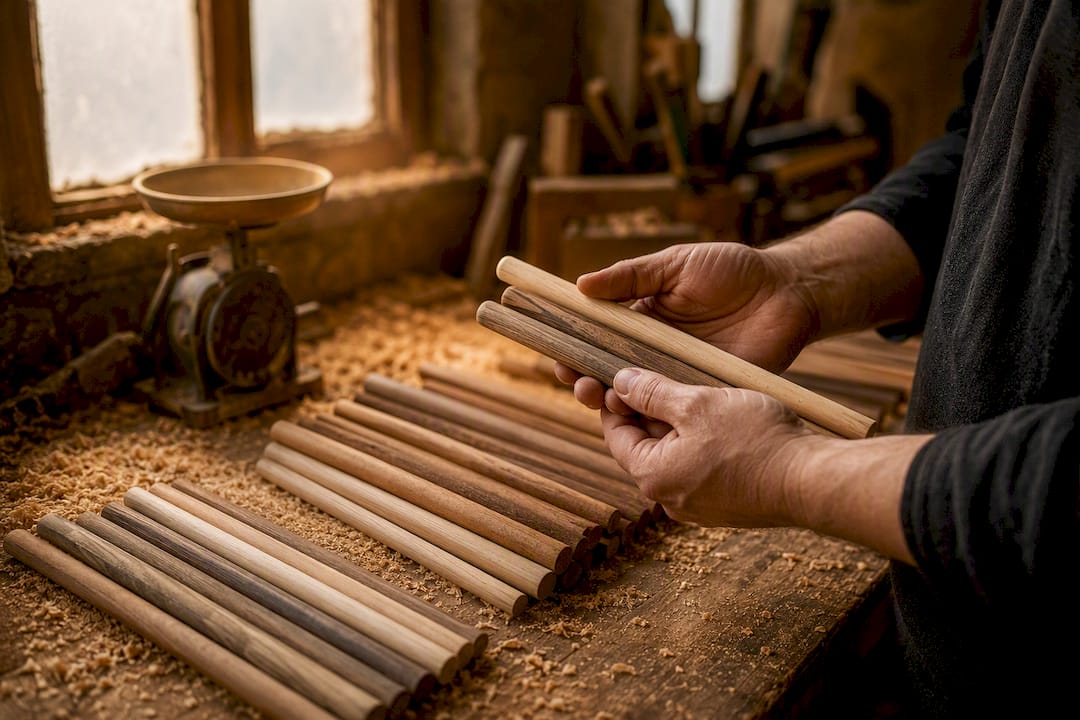
This is why some manufacturers list both weight matched and pitch matched directly on the product page as quality features rather than as an upsell. Meinl’s product listings are a clear example of a brand treating pre-shaping dowel sorting as a standard QC step, not a premium add-on.
Key parts of the process:
- Dowel batching: raw blanks are grouped by density and moisture before shaping begins.
- Model-based weight classes: brands often ship the same model in multiple weight classes within a single production run, meaning two “identical” sticks pulled from different bricks can land in different classes.
- Pitch matching: tapping sticks and listening for matched tone, which reflects combined weight, density, and moisture in one quick test.
- Finish variance: lacquer, nylon tips, and barrel shaping all add small, inconsistent mass that pure gram sorting alone won’t catch.
Wood species plays a role too. Hickory tends to run a wider natural density range than maple, so hickory pairs typically need tighter sorting to hit the same tolerance a maple pair reaches more easily.
Measure And Match Your Sticks: A Step-by-Step Workshop and Gig Workflow
You don’t need a lab to do this properly. You need a decent scale, a flat surface, and a system you’ll actually stick to before every gig.
Tools to gather first:
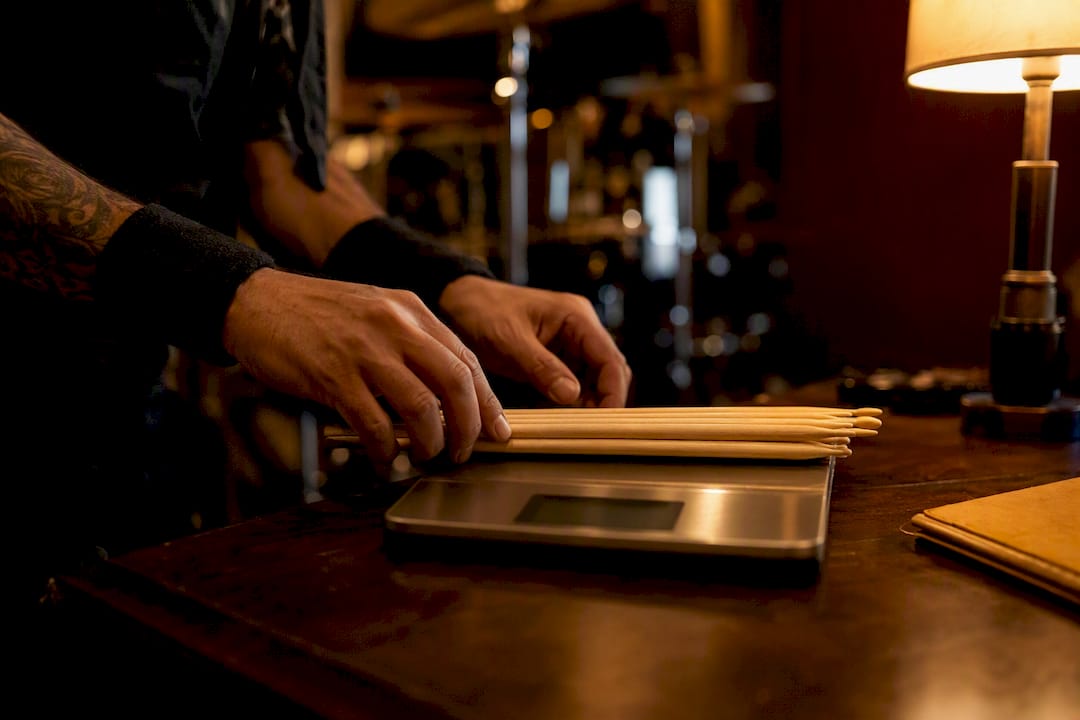
A digital scale accurate to 0.1 grams gives you the cleanest data, though a scale with consistent 0.5 gram repeatability is a workable minimum. Cheap kitchen scales often lack that repeatability and will show you phantom differences that aren’t really there. You’ll also want a soft, non-slip surface to rest sticks on while weighing, and something to tap against, a snare rim or a tuning gauge works, for a quick pitch check alongside the gram reading.
The workflow:
- Lay out every stick from a fresh box or brick before you touch a single pair.
- Weigh each stick individually and write the number directly on masking tape wrapped around the butt end.
- Tap each stick against a hard surface and note the pitch, high, medium, or low is fine as a rough label.
- Pair sticks with the closest gram reading first, then confirm the pitch matches or sits close.
- Mark confirmed pairs with matching colored tape or a shared number.
- Set aside any stick that’s an outlier rather than forcing a bad pair together.
- Repeat until you’ve built as many matched pairs as you need, plus backups.
On-the-fly adjustments are legitimate, not a failure of the process. Some drummers intentionally pair a slightly heavier stick into their weaker hand to balance limb output, a real ergonomic strategy rather than a compromise. If that’s you, label those pairs separately so you don’t accidentally “fix” them later.
Pro Tip: Weigh sticks in the same room temperature and humidity you’ll be playing in whenever possible. A stick that reads perfectly matched in a dry, air-conditioned shop can drift once it absorbs stage humidity for an hour.
For touring rigs, keep six to twelve pre-weighed backup pairs labeled with both weight and pitch, so a broken stick mid-set gets replaced with something that matches feel, not just brand and size. Rotate backups into regular use periodically so you’re not discovering a bad pair for the first time under stage lights.
Practical Tolerances: The Gram Numbers That Actually Matter
Here’s where a lot of well-meaning advice gets vague. The real numbers:
- Within-pair tolerance: reputable manufacturers typically hold pairs to within 1 to 2 grams of each other.
- Between-pair spread: two different pairs of the exact same model, pulled from different bricks, can vary by as much as 7 grams between weight classes.
- Perceptible threshold: many players report noticing a difference once a pair drifts past 2 to 3 grams, though sensitivity varies by grip style and stick diameter.
Wood species shifts what counts as acceptable. Hickory’s wider natural density range means a hickory pair sitting 2 grams apart is unremarkable, while the same 2 gram spread in a denser, more uniform material like a synthetic composite stick would be worth investigating.
Decision rules worth adopting:
- If a pair is within 1 gram, stop worrying and play.
- If a pair sits 2 to 4 grams apart, re-pair with something closer from your stock before deciding it’s unusable.
- If nothing in your current stock closes the gap, that’s when it’s time to buy fresh rather than force a mismatch.
- If a stick is chipped, waterlogged, or visibly warped, replace it outright regardless of what the scale says.
Temple of Sound’s Pro Recommendations and Buying Guidance
Buying weight-checked sticks only helps if the supplier actually does the sorting rather than just printing “weight matched” on the label. At Templeofsound, sourcing through the London Drumstick Co. means dowels get sorted before shaping, not after, the sequence that produces tighter long-term consistency for touring rigs rather than a one-time match that drifts apart with humidity.
Before you buy from any supplier, ask these questions:
- Where does the dowel stock come from, and is it sorted before or after shaping?
- What gram tolerance do they hold within a pair, and what’s the spread between pairs in the same batch?
- Do they offer pitch pairing alongside gram weighing, or gram numbers alone?
- What’s the return or exchange policy if a “matched” pair arrives outside tolerance?
Pro players lean toward weight-checked or fully custom sticks because the cost of a mismatched pair, in fatigue and inconsistent tone, outweighs the small premium. A distributor that offers a custom stick builder alongside standard retail stock gives you both options without switching suppliers mid-season.
The Part of This Guide Most Drummers Skip
Most advice on this topic stops at “buy weight-matched sticks” and calls it solved. That’s incomplete. A pair that matched perfectly at the shop can drift by several grams once it’s been living in a humid van for three weeks of touring, and the scale you own at home is often less reliable than players assume, cheap digital scales frequently show phantom 0.3 gram swings that have nothing to do with the stick.
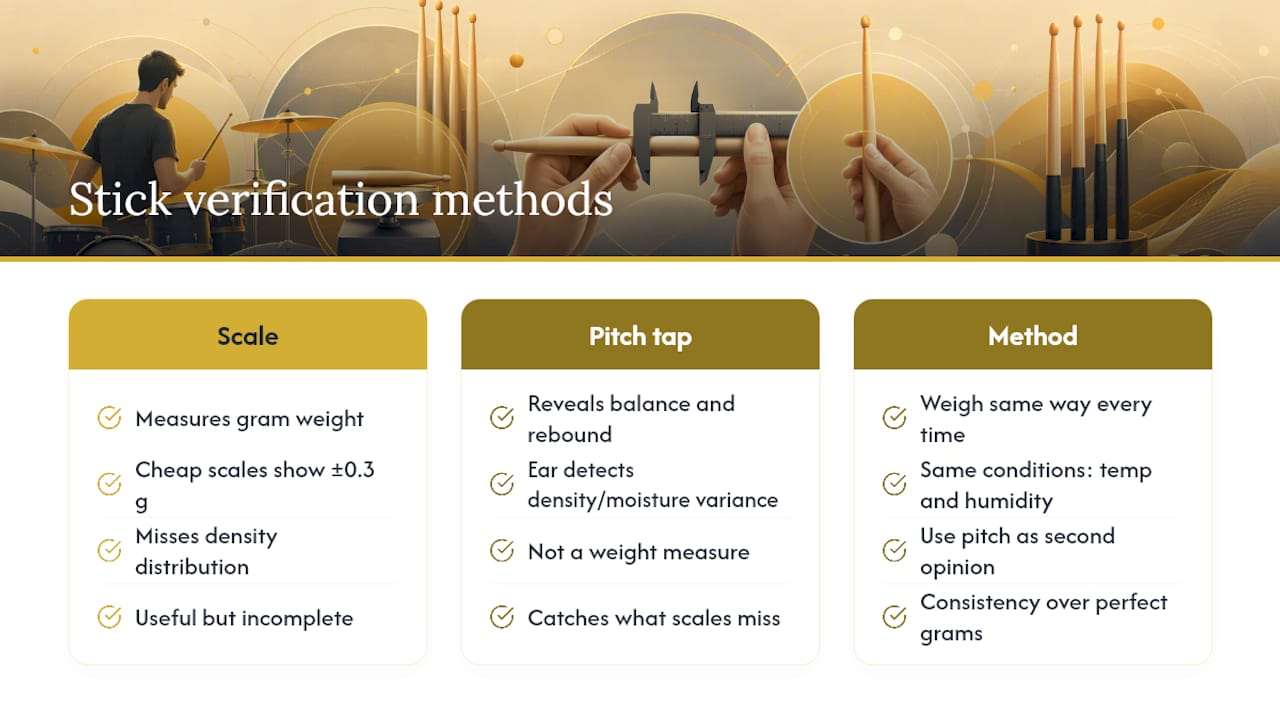
The bigger blind spot is treating gram weight as the whole story. Two sticks can weigh identically and still feel different, because density distribution along the shaft changes balance point and rebound in ways a single number can’t capture. That’s why pairing a gram reading with a quick pitch tap catches problems pure scale numbers miss, the ear picks up density and moisture variance that a scale alone won’t flag.
If you take one thing from this guide, make it this: weigh your sticks the same way, in the same conditions, every single time, and treat pitch as a second opinion rather than an afterthought. Consistency in method matters more than chasing a perfect gram number.
— Will
Get Weight-Checked and Custom Sticks Built for the Set You’re Actually Playing
Templeofsound gives touring and studio drummers something most retail racks can’t: sticks sorted before shaping, not after, plus a custom builder if you need a spec no factory brick will match exactly. That sequencing is what keeps a pair consistent through a three-week tour instead of just at the moment you bought it.

As the UK’s exclusive distributor for the London Drumstick Co. and Alchemist Cymbals, Templeofsound stocks weight-checked pairs alongside a configurable custom stick builder, so you can order to a specific gram tolerance rather than hoping a brick happens to match. Trade accounts get wholesale pricing for retailers, and the membership program adds ongoing discounts for players who order regularly. If fatigue or inconsistent feel has been dogging your sets, check current stick options and place an order built around the tolerances that actually matter for your playing.