16 September 2026
Which Temple of Sound Drummer Rewards Program Tier Pays for Sticks?

Which Temple of Sound Drummer Rewards Program Tier Pays for Sticks?
A drummer rewards program is a percussion retailer’s loyalty scheme that turns routine accessory purchases and occasional instrument purchases into points, store credit, and exclusive experiential perks. Members earn on every stick, cymbal, and drumhead purchase, unlock tiered benefits as they spend more, and get access to workshops or early product drops. It matters most to frequent stick and accessory buyers, drummers saving toward a bigger cymbal or kit, and trade customers. Temple of Sound’s membership tiers, detailed below, put this structure into practice.
TL;DR:
- Reward points are higher on small, frequently purchased items like sticks and heads to encourage repeat replenishment purchases.
- Experiential perks, such as early access and workshops, are more effective at building long-term loyalty than just offering discounts.
- Paid membership tiers generally recoup their cost through faster points earning and exclusive benefits, especially for frequent buyers.
- Loyalty program rules, including point expiration and redemption, should be transparent and clearly communicated before signup.
- Retailers benefit from structured rewards that promote predictable reordering cycles and retain customers within their ecosystem.
Table of Contents
- How Does a Drummer Rewards Program Actually Work?
- What Do Members Actually Get From Rewards Programs?
- How Do You Sign Up and Redeem Points?
- How Can Drummers and Shops Get the Most Value?
- How Does This Compare to General Music Instrument Loyalty Schemes?
- What Do Paid Membership Tiers Actually Cost?
- What Do Real Program Outcomes Look Like?
- Do You Need Special Devices or Software to Join?
- Is Your Personal Data Safe When You Join?
- An Editorial Take on Drummer Rewards Programs
- Which Temple of Sound Membership Tier Fits You?
- Sources
- FAQ
How Does a Drummer Rewards Program Actually Work?
Most programs run on three moving parts: earning, tiers, and redemption. Points typically accrue per dollar spent, though some retailers add flat bonuses for specific actions, like writing a review, referring a friend, or buying a bundled cymbal pack.
Tier structures usually split into free and paid levels. A free tier lets anyone earn baseline points just for creating an account. Paid tiers, often billed monthly, add faster point accumulation, deeper discounts, or perks a casual shopper never sees, like early access to limited stick runs or invitations to drum clinics.
Redemption takes a few common forms:
- Store credit applied at checkout toward future purchases
- Straight percentage discounts on a cart total
- Free items, such as a pair of sticks or a drumhead, once a point threshold is hit
- Reduced or waived shipping costs on qualifying orders
Experiential perks deserve special attention here. Music fans consistently value experiences over plain discounts, and the same psychology applies to gear shoppers who want a reason to stay engaged beyond the transaction. A program that only discounts feels transactional. One that adds a clinic invite or early access to a new cymbal line feels like membership in something.
What Do Members Actually Get From Rewards Programs?
Reward structures work because they target behavior retailers already want to encourage: repeat purchases of small, frequently replaced items. Drumsticks break. Heads wear out. Felts and cymbal sleeves go missing. A well-designed program rewards exactly those purchases at a higher rate than big-ticket items, because that’s where loyalty gets built.
Three reward categories show up most often:
- Replenishment incentives — Bonus points on sticks, heads, and small accessories keep drummers coming back to the same retailer instead of price-shopping every time a pair of 5As wears out. This is the backbone of a well-designed instrument-brand loyalty program, since these are the purchases customers make most often.
- Store credit versus percentage-off — Store credit works better for members saving toward a specific big purchase, like a new cymbal set, because it compounds. A flat percentage discount works better for someone who just wants the current order to cost less right now.
- Milestone and experiential rewards — Early access to a new drumstick model, a seat at a technique workshop, or a meet-and-greet with an endorsed artist.
That third category isn’t a nice add-on. A Live Nation study found 82% of music consumers prefer exclusive experiences over pure discounts, and programs built around live-music perks see stronger sign-up intent and better brand perception.
Pro Tip: If a program offers both a discount option and an experience option at the same point threshold, take the experience. Discounts are replaceable. Workshop seats and early access windows are not.
For retailers, the payoff shows up as a higher repeat-purchase rate and a more predictable reorder cycle, since members who track points toward a goal tend to buy from the same shop instead of splitting orders across competitors.
How Do You Sign Up and Redeem Points?
Joining is usually the easiest part. Most retailers offer three entry points:
- Full account creation on the retailer’s website, where you set up a profile and start earning immediately
- Guest opt-in at checkout, where you link an email address to a purchase without a full account
- Trade account registration for retailers and schools, which typically runs through a separate application process
Once you’re in, the math is straightforward. A common structure gives one point per dollar spent, with bonus points stacked on top for referrals, product reviews, or newsletter sign-ups. Some shop-level programs award a flat percentage back in points. The Drum Center of Portsmouth program, for example, returns 4% of a purchase as redeemable points, though discounted orders and select categories are excluded from earning. That kind of exclusion is standard, so read the fine print before assuming every dollar counts.
Redemption generally happens two ways: automatically at online checkout, where points convert to a discount code, or manually in-store, where staff apply the balance to a purchase. Many programs let you stack points redemption with an existing sale price, though some cap how much of an order can be covered by points alone.
Expiry terms are where fairness gets tested. Reasonable programs give members a 6 to 12 month validity window and reset the clock only after a long stretch of inactivity, not after a single quiet month. Vague terms that let a retailer wipe a balance without warning are a red flag.
Pro Tip: Before you commit to a paid tier, check whether the program discloses its expiry rules in plain language on the same page where you sign up. If you have to dig for that information, treat it as a warning sign about how the rest of the program is run.
You can find a breakdown of how points redemption typically plays out in practice on Temple of Sound’s guide to musician loyalty points.
How Can Drummers and Shops Get the Most Value?
Getting real value out of a program takes a slightly different approach depending on which side of the counter you’re on.
If you’re a drummer:
- Pick one savings goal, like a new ride cymbal, and let points accumulate toward it instead of redeeming small amounts constantly
- Choose a program with a clearly visible running balance, not one that requires a support ticket to check
- Prioritize programs that give bonus earning on replenishment items you buy anyway, like sticks and heads
If you run a retail operation:
- Set generous earning rates on low-price, high-frequency items rather than concentrating rewards only on big-ticket instruments
- Issue predictable rewards certificates or monthly statements so members have a reason to check back in
- Segment offers by instrument profile. A cymbal buyer and a stick-focused player respond to different promotions.
Trade and school accounts need their own rulebook entirely. Programs like SABIAN’s school rewards system run on annual qualifying windows and require receipt submission rather than automatic point tracking, with redemptions tied to cumulative purchases over that period. That’s a fundamentally different administrative process from a consumer checkout flow, and retailers who blend the two without separating the rules confuse both sides.
Communication cadence matters more than most retailers admit. A monthly statement, a milestone email when a member crosses a point threshold, and an early-access invite before a product launch each give a member a reason to open an email instead of ignoring it. Retention tactics like segmentation and predictable cadence apply directly here, even though they’re written for a broader retail audience.
How Does This Compare to General Music Instrument Loyalty Schemes?
Generic music-instrument loyalty programs tend to treat a $15 drumstick pair and a $3,000 kit the same way: flat points per dollar, one redemption menu, no distinction between replenishment and aspiration purchases. That approach misses what makes percussion buying different from, say, buying a guitar.
Drummers replace sticks and heads constantly. A program built around that rhythm rewards frequency, not just total spend. A cymbal buyer, on the other hand, might make one large purchase every few years. Treating both buyer types identically means the frequent accessory shopper gets under rewarded relative to how often they interact with the brand, while the occasional big spender gets rewarded once and then disappears from the loyalty loop entirely.
The stronger design, and the one percussion-focused retailers are better positioned to build, weights points differently by category: higher per-dollar rates on sticks, heads, and small accessories, standard rates on mid-tier gear, and milestone or experiential perks tied to larger purchases like a new cymbal set. That structure keeps frequent buyers engaged month to month and gives occasional big spenders a reason to feel like more than a one-time transaction.
Programs distributed through a single exclusive source, rather than assembled from a wide multi-brand marketplace, also tend to have simpler terms. Fewer product lines means fewer exclusion categories buried in fine print, which is one of the more common complaints about broader instrument loyalty schemes.
What Do Paid Membership Tiers Actually Cost?
Most drummer rewards programs offer a free entry tier and one or more paid tiers that unlock faster earning or deeper perks. The free tier is the right starting point for anyone testing whether a retailer’s product line fits their playing style, since there’s no commitment and no risk.
Paid tiers earn their monthly cost back through a combination of faster point accumulation, member-only discounts, and access to perks that aren’t available at the free level, like early product access or workshop invitations. Whether that math works out depends entirely on purchase frequency. A drummer who buys a fresh pair of sticks every few weeks and picks up cymbals or heads a few times a year will typically recoup a paid membership fee faster than someone who buys gear once a season.
The honest value question isn’t “does this tier cost money,” it’s “does my buying pattern match what this tier rewards.” A player who mostly buys once a year and rarely touches accessories gets less out of a paid tier than someone restocking sticks monthly. Before upgrading, add up your last twelve months of purchases and estimate the points and discounts you would have earned at each tier level. If the paid tier’s monthly cost is covered by even one redeemed reward across that period, it’s paying for itself.
What Do Real Program Outcomes Look Like?
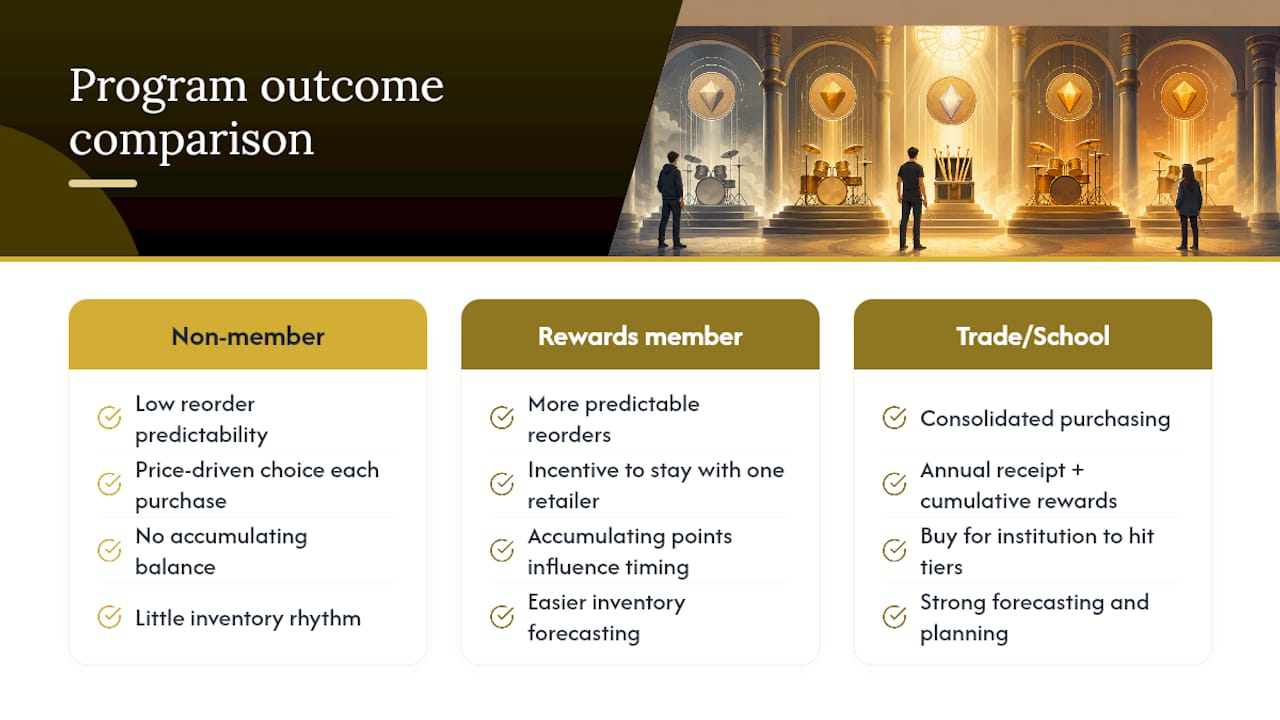
The clearest evidence for how these programs perform comes from side-by-side behavior: members who earn on replenishment items reorder more predictably than members who don’t.
Consider two hypothetical but representative buying patterns. A drummer who buys sticks only when the old pair breaks, with no loyalty account, has no reason to return to the same retailer twice in a row. Price becomes the only deciding factor every single time. A drummer enrolled in a points program that rewards stick and head purchases at a higher rate has a running incentive to keep buying from one source, since switching retailers means abandoning an accumulating balance.
Retailers see the mirror image of that behavior. Shops running structured rewards programs report more predictable reorder cycles, because members timing their purchases around point thresholds or upcoming certificates create a rhythm that’s easier to forecast than pure walk-in traffic. That predictability matters for inventory planning on high-turnover items like stick pairs and drumheads.
Trade and school programs produce a different kind of case study. A school program that requires annual receipt submission and rewards cumulative purchases over that window pushes music educators to consolidate their buying with one supplier rather than splitting orders across several, simply because consolidating makes hitting the next redemption tier realistic. That’s a structural incentive most consumer-facing programs don’t need, since individual shoppers don’t typically manage bulk annual purchasing on behalf of an institution.
Do You Need Special Devices or Software to Join?
No special hardware or app download is typically required. Most drummer rewards programs run entirely through a retailer’s existing website, so any device with a browser, phone, tablet, or desktop, works for account creation, point tracking, and redemption.
Account setup usually happens one of two ways: a full registration form completed before your first purchase, or an opt-in during checkout that links your email to future orders automatically. Trade accounts for retailers and schools generally go through a separate registration path with its own verification step, since those accounts unlock wholesale-level pricing rather than consumer point rates.
Checking your balance doesn’t require anything beyond logging into your account on the retailer’s site. Automated point tracking on consumer e-commerce checkouts happens instantly, while B2B and school programs often rely on manual receipt submission tied to a fixed annual window rather than real-time tracking. If you’re setting up a trade account for a shop, Temple of Sound’s guide to trade account setup walks through what’s needed on that side specifically.
The one thing worth checking before enrolling: whether the retailer’s site clearly shows your running point balance without needing to contact support. A program that hides your balance behind a customer service request is a program that’s harder to trust.
Is Your Personal Data Safe When You Join?
Enrolling in a rewards program means handing over an email address at minimum, and a full account typically adds a name, shipping address, and purchase history. That data lets a retailer track your points balance and personalize offers, but it’s worth understanding what you’re sharing before you opt in.
Reputable percussion retailers use standard e-commerce security practices: encrypted checkout pages, secure account login, and no storage of full payment card details on their own servers, since that’s handled by a payment processor instead. What varies more between retailers is how they use your purchase history for marketing. Some programs send targeted offers based on what you’ve bought before, like a stick-replacement reminder timed to when your last pair likely wore out. That’s a reasonable use of purchase data. Selling that data to unrelated third parties is not, and it’s worth checking a retailer’s privacy policy for that distinction specifically.
Trade and school accounts often involve more sensitive information, since a school registration may include institutional details tied to a budget or purchasing officer. Those accounts deserve the same scrutiny as any B2B vendor relationship: confirm who has access to the account data and how long records are retained.
Before enrolling anywhere, a quick check of the retailer’s privacy policy tells you whether your email will end up in a marketing list you didn’t explicitly agree to, and whether you can delete your account data on request.
An Editorial Take on Drummer Rewards Programs
Most rewards programs in the music gear space get built by copying a generic e-commerce loyalty template and slapping a drum graphic on it. That’s the wrong starting point. A drummer’s buying pattern doesn’t look like a typical retail customer’s. You’re not buying a jacket twice a year. You’re replacing sticks and heads constantly, saving toward one big cymbal purchase over months, and occasionally wanting access to something a discount code can’t buy, like a seat at a clinic or early hands-on time with a new stick model before it’s publicly available.
The programs that get this right treat replenishment items as the core of the system, not an afterthought bolted onto a rewards menu built around big-ticket instruments. Temple of Sound’s exclusive UK distribution of London Drumstick Co. and Alchemist Cymbals puts the company in a position to design tiers around exactly that rhythm, rather than treating a stick order and a cymbal order as interchangeable transactions. Temple of Sound’s breakdown of loyalty points mechanics and its artist endorsement guidance both point toward the same conclusion: the experiential side of a rewards program, not just the points balance, is what keeps a drummer engaged past the first redeemed discount.
I’d argue the industry still underrates experiential perks relative to how much fans actually want them. A discount code gets used once and forgotten. A workshop invite or early access to a limited stick run gets talked about.
— Will
Which Temple of Sound Membership Tier Fits You?
Temple of Sound built its membership around the buying pattern most drummers actually have: frequent small purchases, occasional big ones, and a real interest in getting closer to the gear before everyone else does. The Free Member tier costs nothing and gets you started earning on every order. The paid membership tiers include one that offers faster point accumulation and member pricing on replenishment items like sticks and heads. A higher tier adds experiential perks such as early access to new product drops and priority invitations to workshops and events.
If you’re restocking sticks every few weeks, the math on Pro or VIP tends to work out fast. If you’re buying once or twice a year, Free is the sensible starting point until your habits change. Retailers and shop owners interested in a trade account route should start with Temple of Sound’s guide to setting up a trade account before applying.
Compare all three tiers and sign up directly on the Temple of Sound membership page to see current benefits at each level.
Sources
- Live Music Is Becoming a Key Loyalty Tool for Brands
- Best Loyalty Program for Musical Instrument Brands
- Redeem - SABIAN School Music Rewards Program
- Loyalty Program or “Points” : Drum Center of Portsmouth
FAQ
What Is a Drummer Rewards Program?
It’s a loyalty scheme run by a percussion retailer that awards points, store credit, or experiential perks for purchasing drumsticks, cymbals, heads, and other gear, with tiers that unlock added benefits.
How Do I Earn Points in a Drummer Rewards Program?
Most programs award points per dollar spent, with bonus points for actions like referrals or product reviews, and some retailers give higher rates on frequently replaced items like sticks and heads.
Do Points Expire?
Reasonable programs use a 6 to 12 month validity window and reset balances only after extended inactivity, so check a retailer’s terms before assuming points last indefinitely.
What Does Temple of Sound’s Membership Cost?
Temple of Sound offers membership tiers including a free tier and paid tiers with monthly fees, each unlocking progressively faster earning and experiential perks.
Are Trade Accounts Different From Consumer Rewards Accounts?
Yes. Trade and school accounts typically require separate registration and often run on annual qualifying windows with receipt submission, unlike automatic point tracking on consumer checkouts.