17 September 2026
From £4.99/mo: Drummer Membership Benefits for Drummers & Retailers

From £4.99/mo: Drummer Membership Benefits for Drummers & Retailers
Drummer membership benefits come down to five things: percentage discounts on gear, loyalty points that stack toward future purchases, trade pricing for retailers, priority access to custom drumstick builds and limited cymbal runs, and early alerts on exclusive product drops. Casual buyers usually break even fast on a free or low-cost tier. Gigging players and retailers who buy several times a year get real value from paid tiers and trade accounts, especially through distributors like Templeofsound that hold exclusive rights to brands like London Drumstick Co. and Alchemist Cymbals.
TL;DR:
- Rewards from memberships are most valuable for frequent buyers and retailers, especially through trade accounts that offer bulk discounts and exclusive product access.
- Discount savings can quickly outweigh membership fees for gigging drummers spending thousands annually, but lower-spending hobbyists might find free tiers sufficient.
- Loyalty points often expire or have minimum redemption thresholds, so tracking purchase history is crucial to maximizing their value.
- Custom drumsticks and limited cymbal runs are generally accessible only to higher tiers, with added deposits, longer lead times, and allocation that favors endorsed artists first.
- Membership perks include early alerts on exclusive product drops, priority support, educational content, and networking opportunities, which are especially beneficial for active professionals and retailers.
Table of Contents
- What Do Free, Pro, and VIP Drummer Membership Tiers Include?
- How Do Discounts and Loyalty Points Actually Add Up?
- What Do Trade Accounts Require and What Do Retailers Get?
- How Does Membership Unlock Custom Drumsticks and Limited Cymbal Runs?
- How Do You Join, Verify, and Keep a Membership Active?
- What Should You Check Before You Join a Drummer Membership?
- What Community and Networking Opportunities Come With Membership?
- What Educational Content Do Drummer Memberships Typically Unlock?
- Do Drummer Memberships Include Competitions or Giveaways?
- Does Membership Come With Priority Customer Support?
- What Partnership Perks Come Bundled With Membership?
- Publisher Perspective: Memberships as Relationship Platforms
- Join Templeofsound: Free, Pro, and VIP Membership
- Where These Membership Norms Come From
- Sources
- FAQ
What Do Free, Pro, and VIP Drummer Membership Tiers Include?
Most percussion retailers structure membership the same way subscription services do everywhere else: a free entry tier to build the list, a mid-tier for regular buyers, and a top tier for serious spenders. Templeofsound follows this pattern with Free Member, Pro Member, and VIP Member plans, each opening up more of the catalog and more savings as you move up.
A free tier usually gets you newsletter access, basic loyalty point accrual, and maybe first notice on sales. It costs nothing and asks for nothing beyond an email address. A mid-tier, priced around a few dollars a month, typically adds a real discount percentage on every order, faster point accumulation, and access to member-only sales windows before the general public sees them.
Top-tier membership is where things get interesting for people who actually live on their gear. Expect the deepest discounts, first access to limited cymbal runs, private pricing on select items, and sometimes a dedicated contact for questions or custom orders.
Here’s how the tiers typically map to who benefits most:
- Free tier: Beginners and occasional buyers who want alerts without commitment.
- Pro tier: Gigging drummers replacing sticks and heads regularly, students building a kit over time.
- VIP tier: Working professionals, session players, and small retailers who order frequently enough that the discount pays for the membership several times over.
Reference the VIP membership model some retailers use for a sense of what top-tier perks look like in practice: confidential pricing, early gear alerts, and private instructional content.
How Do Discounts and Loyalty Points Actually Add Up?
Discounts and loyalty points are two different levers, and confusing them is the most common reason a membership feels disappointing. A discount reduces the price at checkout. Loyalty points accumulate as a percentage of what you spend and get redeemed later, usually against future orders. Some brands inside a distributor’s catalog get excluded from either mechanism, so a headline “10% off everything” often means “10% off everything except the items already on promotion or under a manufacturer pricing floor.”
Two quick examples show how the math plays out:
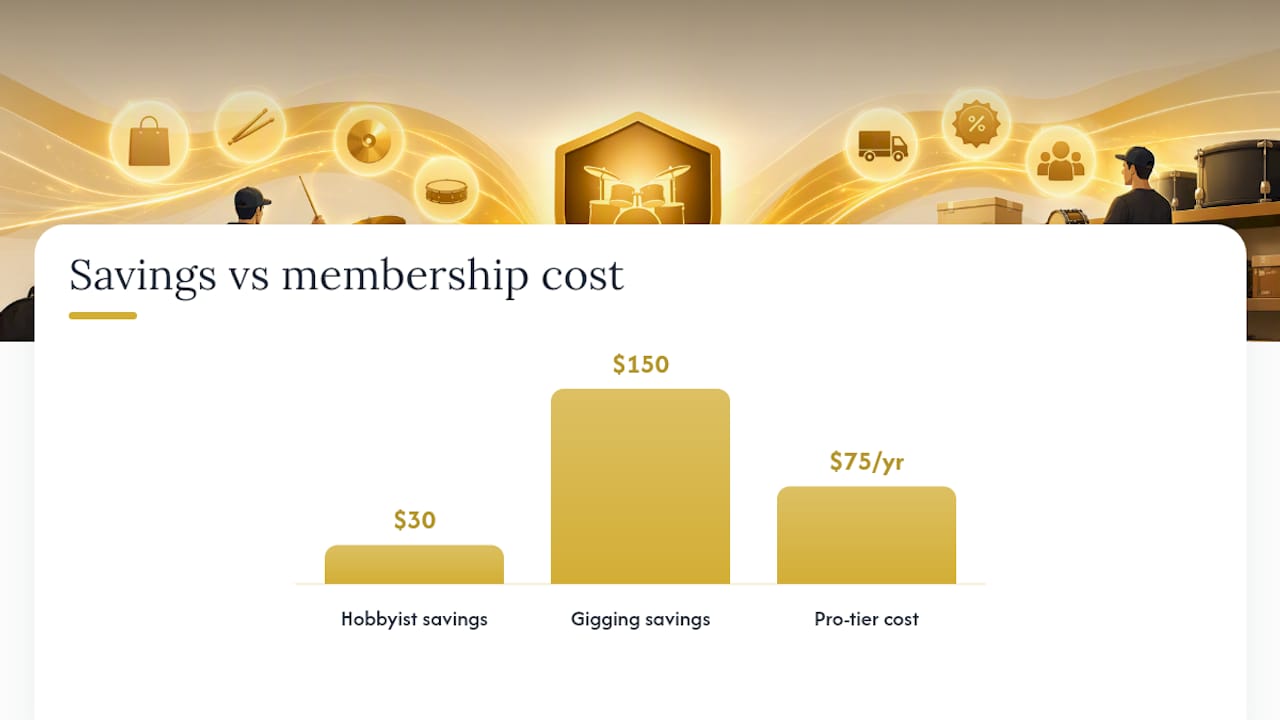
- Hobbyist drummer: Spends around $300 a year on sticks, heads, and accessories. A Pro-tier membership at £4.99 a month costs roughly $75 a year (converted from GBP at typical exchange rates), so a 10% discount only saves about $30. Unless the tier adds real extras, this buyer might do better on a free tier.
- Gigging drummer: Spends $1,500 a year replacing sticks, heads, and cymbals after wear. That same discount saves $150, more than double the membership cost, and loyalty points on top push the value higher.
Pro Tip: Track your last twelve months of receipts before joining anything. Membership value is a math problem, not a feeling, and most people overestimate how often they actually buy.
Watch for redemption minimums and expiration windows on points. A program that lets points sit unused for a year without expiring is worth more than one that pressures you to spend fast. Templeofsound’s approach to loyalty points breaks down redemption mechanics in more detail for members trying to squeeze full value from the program.
What Do Trade Accounts Require and What Do Retailers Get?
Trade accounts exist for shops and studios buying in volume, not individual drummers buying a pair of sticks at a time. The standard package includes wholesale pricing tiers, bulk-quantity discounts that scale with order size, and often a dedicated account manager who handles restocks and special requests directly instead of routing through general customer service.
Getting approved usually means proving you’re an actual business. Distributors typically ask for a business registration number, a tax ID, and sometimes a reseller certificate confirming you’re buying to resell rather than for personal use. Minimum opening orders are common, and many trade agreements come with resale rules: online listings can’t undercut minimum advertised pricing, and in-store display expectations sometimes apply too.
Before applying for any trade account, retailers should confirm:
- Minimum opening order and reorder thresholds.
- Whether pricing tiers unlock automatically at spend milestones or require renegotiation.
- Resale and advertising restrictions for online listings.
- What documentation the distributor actually requires versus what’s just recommended.
Pro Tip: Ask for the resale policy in writing before you sign anything. A verbal “you can price however you want” from a sales rep means nothing if the actual agreement says otherwise.
Templeofsound’s shop account setup guide walks through the practical steps for retailers opening a trade account for the first time, and the wholesale percussion buying guide covers what serious buyers should expect from supplier relationships more broadly. Association-level examples, like NAMM’s membership categories, show how larger industry bodies structure dues against tangible perks like show badges, a useful benchmark when negotiating your own trade terms.
How Does Membership Unlock Custom Drumsticks and Limited Cymbal Runs?
Custom-spec drumstick orders, engraved sticks, and curated cymbal packs are usually where membership tiers earn their keep beyond simple percentage discounts. Members typically get first access to limited production runs before they’re listed publicly, along with priority queue placement when demand for a custom build outpaces supply.
Before committing to a custom order, ask about:
- Deposit requirements: Many custom builds require partial payment upfront.
- Lead times: Hand-finished sticks or small-batch cymbals can take weeks longer than stock inventory.
- Minimum order quantities: Relevant mainly for retailers ordering custom-branded stick runs for their own shop.
- Endorsement-linked access: Some allocation for limited runs goes first to artists in a distributor’s endorsement program, which affects how fast general members can get in line.
Distributor-brand relationships matter here more than people realize. An exclusive distribution partnership, like the one Templeofsound holds for London Drumstick Co. and Alchemist Cymbals, means membership at that specific retailer is the only route to certain product lines. Reading up on the difference between endorsement and sponsorship helps clarify how these relationships shape who gets first access.
How Do You Join, Verify, and Keep a Membership Active?
Joining is usually fast for individual drummers and slightly slower for retailers waiting on trade verification.
- Create an account on the distributor’s site and pick a tier based on your buying frequency.
- Submit verification documents if applying for trade status: business registration, tax ID, and reseller certificate where required.
- Confirm billing details and set calendar reminders ahead of renewal dates to avoid surprise charges.
- Turn on alerts for sales windows, limited drops, and point balance updates so the membership doesn’t just sit there unused.
Retailers should scan and organize documents before starting the application. Verification delays are almost always caused by missing paperwork, not slow processing on the distributor’s end. Once approved, the single best habit is checking your points balance quarterly. Unused points are the most common way members lose value they already paid for.
What Should You Check Before You Join a Drummer Membership?
Run the break-even question first: does your expected annual spend, multiplied by the discount rate, exceed the membership fee? If the answer is close or negative, a free tier probably serves you better than a paid one.
Beyond the math, ask direct questions before signing up:
- Are points transferable or do they expire after a fixed window?
- Does auto-renewal require active cancellation, or does it lapse automatically without a card on file?
- Which brands or product categories are excluded from member discounts?
- For retailers: are co-op marketing funds and event access included, or sold separately?
Pro Tip: Treat “dealer-only pricing available on request” as a yellow flag. Legitimate trade programs post their tier structure clearly. Vague pricing usually means the numbers change based on how much you negotiate, not a fixed policy.
Watch for aggressive auto-renewal language buried in terms and conditions. A membership that’s genuinely worth keeping doesn’t need to make cancellation difficult.
What Community and Networking Opportunities Come With Membership?
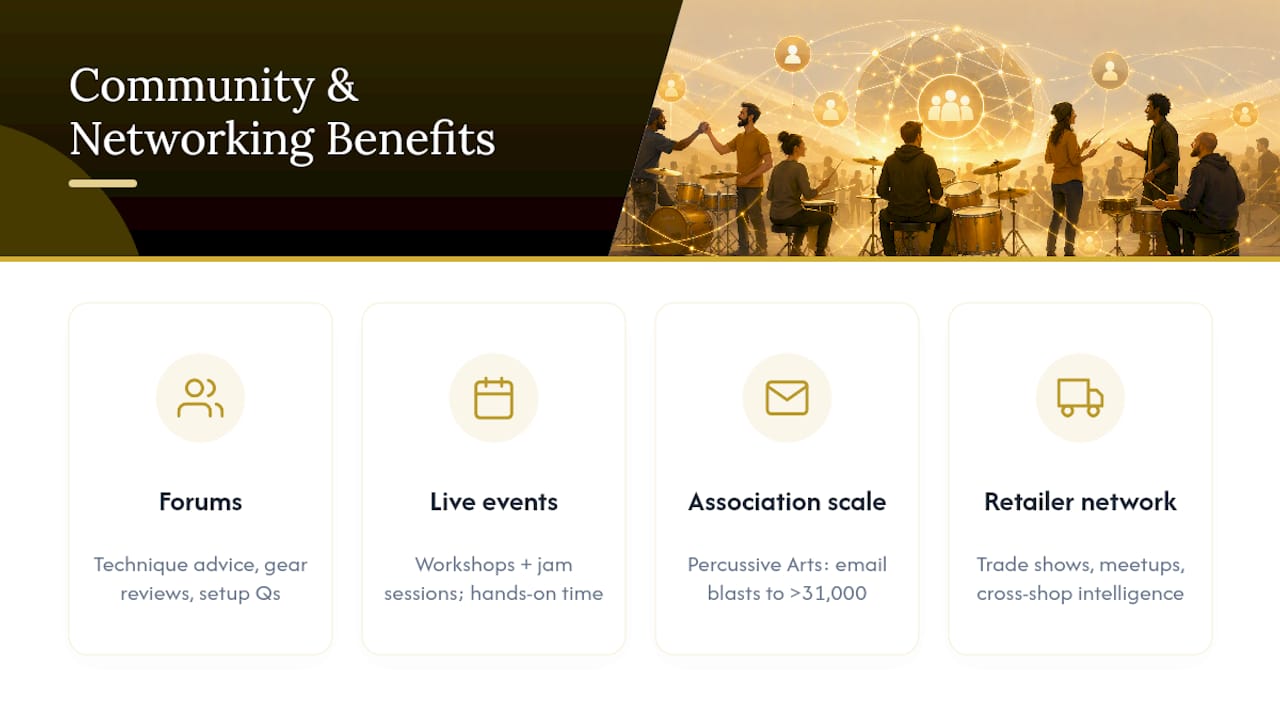
Membership tiers increasingly bundle access to people, not just products. Forums attached to a membership program let drummers trade technique advice, post gear reviews, and ask setup questions to people who’ve actually used the equipment, which beats scrolling generic gear forums where half the responses are guesswork.
Live events matter more than most drummers expect going in. Workshops hosted by a distributor or its endorsed artists give members hands-on time with gear before buying, plus direct access to players whose opinions actually carry weight. Jam sessions organized around these events turn a transactional membership into something closer to a standing invitation.
The scale of association-level networking shows what’s possible when a membership program invests seriously in community. The Percussive Arts Society’s corporate membership structure includes custom email blasts reaching more than 31,000 members, a scale most individual retailers can’t match but a useful benchmark for what a well-run membership community delivers.
Retailers benefit from networking too, often more than individual drummers do. Trade shows, distributor-hosted meetups, and cross-shop forums let smaller shops share intelligence on what’s selling, what’s not, and which suppliers are worth the hassle. A retailer isolated from that network is flying blind compared to one plugged into a distributor’s trade community.
The value here compounds. A member who shows up to two workshops a year and posts occasionally in a forum builds relationships that pay off in ways a discount code never will, whether that’s getting first word on a restock or getting real answers about gear from someone who’s actually played it.
What Educational Content Do Drummer Memberships Typically Unlock?
Paid tiers frequently gate the best instructional content behind membership, and it’s worth understanding why. Technique videos, masterclasses from endorsed artists, and sheet music transcriptions cost real production money to create. Distributors that fund this content need a reason to keep making it, and membership fees are usually that reason.
The quality gap between free tutorials scattered across the internet and curated masterclass content from artists a distributor actually endorses can be significant. Free content tends toward general technique. Member-exclusive content tends toward specifics: how a particular artist tunes their kit, how a stick’s weight distribution changes a rudiment’s feel, or how to approach a technique that’s hard to explain without seeing it demonstrated by someone who’s mastered it.
Sheet music access matters more to some players than others. A member who’s building a repertoire benefits enormously from a library of transcriptions they’d otherwise have to buy piecemeal or transcribe by ear. A player mostly playing covers by feel might never touch that resource.
The practical test for whether educational content justifies a membership tier: would you pay for this content on its own? If a masterclass series or technique library would cost more standalone than the membership fee itself, the education alone covers the cost, and every discount or loyalty point on top becomes pure upside.
Do Drummer Memberships Include Competitions or Giveaways?
Member-only competitions and giveaways show up frequently in tiered membership programs, usually as a retention tool more than a headline feature. Access typically scales with tier: free members might get entered automatically into occasional drawings, while paid tiers get better odds, more frequent entries, or exclusive competitions closed to lower tiers entirely.
Giveaways tend to feature exactly the kind of product that’s hardest to get otherwise, limited cymbal finishes, prototype sticks, or artist-signed gear. That’s not an accident. Distributors use giveaways to generate excitement around products they want members talking about, which is also why timing them around new product launches or limited runs is common.
The value of this benefit is genuinely hard to quantify compared to a straightforward discount. A competition entry is a chance, not a certainty. Treat competitions and giveaways as a bonus layered on top of the concrete benefits, not a reason to join a membership on their own. If a program’s marketing leans heavily on “you could win” language without clear discount or loyalty structure underneath, that’s worth noticing.
Retailers occasionally get access to a different kind of giveaway: co-branded promotional stock they can use for in-store contests or customer appreciation events. That’s a genuine trade perk worth asking about specifically, since it doesn’t always get listed alongside consumer-facing giveaways in marketing material.
Does Membership Come With Priority Customer Support?
Support prioritization is one of the more underrated membership perks, particularly for retailers and gigging musicians who can’t afford to wait days for a response when something goes wrong with an order. Paid tiers commonly include a dedicated contact or a faster response-time commitment compared to the general customer service queue.
For individual drummers, this usually means fewer form-letter responses and quicker resolution when a custom order needs adjustment or a shipment goes missing before a gig. For retailers, dedicated account manager access is often bundled directly into trade account terms rather than sold as a separate perk, since ongoing relationships between a distributor and a shop depend on fast, direct communication.
The practical difference shows up most during high-demand periods. When a limited cymbal run drops or a popular stick model runs short, general customers wait in a queue while VIP-tier and trade-account members often get a heads-up or a hold placed on stock before public availability. That’s not favoritism for its own sake. Distributors have a business reason to protect their highest-value relationships first.
One thing to verify before assuming this benefit exists: ask specifically whether “priority support” means a faster email response, a phone line, or a named contact person. Marketing language around this benefit varies widely between vague (“priority assistance”) and concrete (“your account manager’s direct line”), and the concrete version is worth considerably more.
What Partnership Perks Come Bundled With Membership?
Cross-brand partnerships have become a standard feature of well-run membership programs, extending value beyond the distributor’s own catalog. A percussion-focused membership might bundle discounts with drum lesson platforms, music venue partnerships, or gear insurance providers, essentially turning one membership fee into a bundle of adjacent perks.
These partnerships work because the audiences overlap almost perfectly. A drummer who buys sticks and cymbals also needs practice space, insurance for expensive gear, and often instructional resources, so a distributor partnering with providers in those categories creates value without having to build those services itself.
For independent musicians looking at the wider landscape of paid services worth bundling into a music career, it’s worth comparing how services supporting independent musicians structure their own paid tiers around event access and promoter connections. That comparison is useful context for understanding what “membership” tends to mean across the broader music industry, not just within a single gear distributor’s program.
The retailer version of this benefit usually looks different: co-op marketing arrangements, joint promotional campaigns with the brands they carry, or bundled trade discounts across multiple product lines from the same distributor. A retailer with a trade account for one brand sometimes gets preferential terms extended automatically to a partner brand under the same distribution umbrella, which is worth asking about directly rather than assuming.
Publisher Perspective: Memberships as Relationship Platforms
Treating a membership like a coupon code misses the point. The real value sits in what it funds: education, artist support, and access you can’t buy piece by piece. Exclusive distribution for London Drumstick Co. and Alchemist Cymbals only matters if members actually use the endorsement resources built around it, not just the discount line.
— Will
Join Templeofsound: Free, Pro, and VIP Membership
Templeofsound’s membership offers access to select premium drumsticks and cymbals, providing members with routes to exclusive product lines and limited runs not commonly available through other retailers.
Each tier suits a different kind of buyer. Free Member works for anyone who wants alerts and basic point tracking with no commitment. Pro Member, at £4.99 a month, fits gigging drummers replacing sticks and heads regularly enough that the discount clears the fee within a couple of orders. VIP Member, at £9.99 a month, suits working professionals and small retailers who want first access to limited Alchemist cymbal packs and custom London Drumstick Co. builds before general release.
Pick the tier that matches your buying frequency, not the one with the flashiest perks list. Head to the Templeofsound membership page to compare the three tiers directly and sign up in a few minutes.
Where These Membership Norms Come From
Trade and retailer membership structures referenced here draw on how established organizations run their own tiered programs. The Percussive Arts Society illustrates association-level trade perks. NAMM shows how industry dues map to tangible retailer benefits. The Academic Alliance demonstrates tiered qualification models for education-focused programs, and a real-world VIP membership example grounds the perks discussed in actual retail practice.
Sources
- Corporate Membership - Percussive Arts Society
- Membership categories - NAMM
- Membership Criteria | Academic Alliance
FAQ
What Are the Main Benefits of a Drummer Membership?
The core benefits are product discounts, loyalty points that accumulate toward future purchases, trade pricing for retailers, and priority access to custom drumstick builds or limited cymbal runs. Higher tiers typically add faster point multipliers and early alerts on exclusive drops.
How Much Does a Templeofsound Membership Cost?
Templeofsound offers a Free Member tier with no published price, a Pro Member tier at £4.99 a month, and a VIP Member tier at £9.99 a month. Each tier unlocks progressively deeper discounts and earlier access to exclusive product releases.
Do I Need a Business License for a Trade Account?
Most distributors require proof you’re operating a legitimate business, typically a business registration number and tax ID, sometimes alongside a reseller certificate. Requirements vary by distributor, so confirm the exact documentation list before applying.
Are Loyalty Points Worth More Than a Straight Discount?
It depends on redemption terms and how often you buy. A straight discount saves money immediately, while loyalty points require enough future purchases to redeem meaningfully, so frequent buyers usually get more total value from a points-plus-discount structure than occasional buyers do.
Can Retailers Get the Same Custom Drumstick Access as Individual Members?
Retailers with an active trade account typically get access to custom-spec builds for resale, often at different minimum order quantities than individual members ordering personal sets. Lead times and deposit requirements generally apply to both, though bulk orders may carry longer production windows.