5 September 2026
Drum Accessory Essentials That Fix Most Gig Failures in 60 Seconds
Drum Accessory Essentials That Fix Most Gig Failures in 60 Seconds
Every drummer should carry a drum key and multi-tool, a stick bag stocked with backups, spare drumheads and hardware parts, lossless earplugs, a marked rug, a metronome, and a compact maintenance pouch. That combination stops the failures that actually derail gigs: a stripped tension rod, a lost wing nut, a shredded eardrum after a loud set. Some drum accessory retailers build their accessory lineups around exactly this priority order.
TL;DR:
- A drum key and multi-tool are the most critical accessories for quick repairs, especially for loosening tension rods or replacing worn hardware during gigs.
- Carry multiple pairs of drumsticks in a well-organized stick bag, matching tips to your genre, and selecting sticks by weight to prevent fatigue.
- A compact emergency kit should include spare tension rods, wing nuts, cymbal felts, a hi-hat clutch, and other small parts, stored separately from your home maintenance supplies.
- Use lossless earplugs instead of foam to avoid uneven attenuation, protecting your hearing while maintaining accurate sound perception during rehearsals and performances.
- Regularly inspect and tighten hardware, store spare heads flat, and mark your setup to reduce setup time and prevent common failures like loose cymbals or worn felts.
Table of Contents
- What Are Drum Accessory Essentials, Really?
- The Gig Emergency Kit: What Goes In the Pouch
- Keep Your Kit Reliable: A Fast Maintenance Routine
- Packing and Transport: Setup Speed Starts in the Van
- Hearing Protection: The One Accessory Most Drummers Skip
- Small Upgrades Worth the Money
- Behind the List: Temple of Sound and Will
- Drum Key and Multi-Tool: The Non-Negotiable
- Drum Rug and Hardware Protection
- Maintenance Kit and Emergency Parts
- Practice Pads and Headphones or In-Ear Monitors
- Cymbal Felts and Sleeves: Small Parts, Big Protection
- Drum Throne Selection and Comfort
- Lubricants and Cleaning Supplies for Drum Hardware
- Moongel and Damping Gels for Overtone Control
- Drum Mutes and Practice Silencers
- The Gear That Actually Prevents Bad Gigs
- Where to Find These Essentials
- Sources
What Are Drum Accessory Essentials, Really?
Most gear lists rank accessories by price or novelty. That’s backward. The right question is: what breaks most often, and what fixes it in under sixty seconds? A drum key does that. So does a spare hi-hat clutch. A $200 practice pad does not, no matter how good it feels under your sticks.
Here’s a prioritized rundown, ordered by how often each item saves a set:
- Drum key and multi-tool. This is the one item you never leave home without. Get a continuous-motion key (no lifting and repositioning between turns) and consider a multi-tool with a built-in key, wrench, and bit driver. Use case: a snare head loosens mid-set from heat and humidity, and you retune it during a two-minute changeover instead of missing the next song.
- Drumsticks and a proper stick bag. Carry multiple pairs, more than just one backup. Selection tip one: match the tip shape (round for a focused cymbal ping, barrel for a fuller wash) to your genre. Selection tip two: weigh pairs by hand before buying, since two sticks labeled the same model can vary by a gram or more. A stick bag with multiple tube slots keeps pairs separated so you’re not digging through loose sticks in the dark between songs.
- Spare drumheads and hardware parts. One spare snare head, a handful of tension rods, and extra wing nuts weigh almost nothing and take up almost no space. Use case: a rod strips its threads during load in, and the show goes on because you swap it instead of borrowing gear from the opener.
- Hearing protection. Lossless earplugs, not the orange foam ones from the hardware store. Selection tip: pick a filtered model that attenuates evenly across frequencies rather than muffling highs first, since uneven attenuation makes you play louder to compensate.
- A metronome or click source. A tactile metronome or a click app that runs without a phone signal matters more than any pad feature. Use case: rehearsing a new arrangement solo, where feel alone will drift the tempo without you noticing.
- Drum rug and hardware protection. A rug with marked positions stops your kit from creeping across a stage during an aggressive tune, and protects both your hardware and the venue’s floor.
- Practice pad and headphones. For late-night practice or warming up backstage, a pad paired with closed-back headphones lets you work on technique without a single decibel escaping the room.
Budget shoppers should stop at items one through four. Touring players need the full list plus doubles of anything with moving parts.
Pro Tip: Stick weight fatigue is real but fixable. If your forearms burn by the third song, you’re probably playing sticks that are too heavy for your grip. Matching stick weight within a gram or two of what your hands actually need can add twenty minutes of stamina to a long set.
Pro Tip: Lossless earplugs cost more than foam, but foam plugs cut high frequencies disproportionately. That makes cymbals sound dull and pushes you to hit harder to compensate, which defeats the purpose of wearing plugs at all.
The Gig Emergency Kit: What Goes In the Pouch
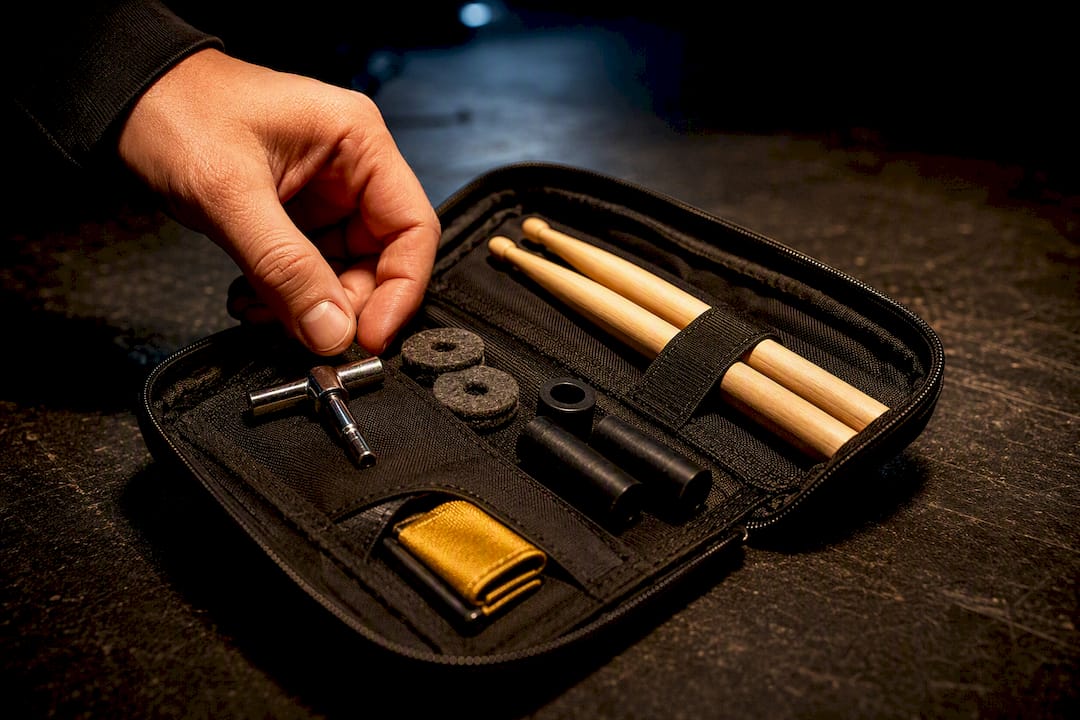
A compact emergency kit commonly includes spare tension rods, wing nuts, cymbal felts and sleeves, a drum key, snare wires, a spare beater, and a hi-hat clutch. Build yours around these:
- Spare beater and bass drum pedal springs
- Extra tension rods (at least six, mixed sizes)
- Wing nuts and cymbal felts/sleeves
- A backup hi-hat clutch
- A small multi-tool with hex keys
- A roll of gaffer tape
- A spare XLR or power cable if you run electronic pads or a module
- Snare wires and a spare snare cord
Keep this pouch inside your stick bag, not buried in a hardware case. Storing high-failure spares in a labeled pouch means you can grab a part without unpacking anything.
Quick troubleshooting: a slipping hi-hat clutch usually means the felt washer is worn, swap it, not the whole clutch. A snapped stick mid-song gets replaced from your second pair, no pause needed. A loose cymbal mount almost always traces back to a missing sleeve or worn felt. A dead e-drum module is usually a power cable, not the module itself, so check that first.
Keep Your Kit Reliable: A Fast Maintenance Routine
Reliability comes from small, repeated checks, not occasional deep cleans. Prioritize mechanical upkeep over anything electronic, since tightening tension rods and inspecting snare wires prevents more onstage failures than any add-on gadget.
- Daily before a gig: check tension rod tightness by hand, inspect snare wire tension, confirm pedal springs aren’t fatigued.
- Weekly at home: wipe down hardware, check cymbal felt condition, lubricate pedal cams and hinges.
- Before travel: store spare heads flat in a hard case, wrap cymbals individually or use dedicated slots in a cymbal bag.
Replace immediately if a head shows a visible dent or crease, a snare wire has a broken strand, or a tension rod thread is stripped. A wobbly lug or slightly worn felt can wait; a cracked cymbal or a rod that won’t hold tension cannot.
Packing and Transport: Setup Speed Starts in the Van
Layout decides how fast you load in. Keep an “on-kit” pouch, the emergency kit above, clipped or zipped inside your main stick bag so it travels with you, not in a separate hardware case someone else might load last.
- Pack sticks upright in tube slots, spares on top for instant access.
- Mark your rug with tape at each stand’s foot position; a pre-marked rug can shave real minutes off soundcheck because nobody’s eyeballing spacing under time pressure.
- Choose soft cases for local gigs where you load your own gear; switch to hard cases once you’re checking bags on flights or handing cymbals to a stagehand you don’t know.
Hearing Protection: The One Accessory Most Drummers Skip
Foam plugs muffle everything unevenly, cutting highs hardest and leaving low end boomy and unclear. Lossless earplugs preserve the natural frequency balance at reduced volume, which is why touring pros favor them over standard foam.
Use in-ear monitors when you need a mix fed to you directly; use filtered earplugs alone for rehearsals and acoustic gigs where there’s no monitor feed. Either way, build the habit: wear protection on every rehearsal over an hour, not just big shows, since cumulative exposure is what actually damages hearing over a career.
Small Upgrades Worth the Money
Once the essentials are covered, a few low-cost extras refine tone and convenience without breaking a budget:
- Moongel or dampening pads tame ringing overtones on snare and toms without killing the tone entirely.
- Quick-lock hi-hat clutches eliminate the classic mid-set clutch slip, a common mechanical failure that a $15 part solves permanently.
- Cymbal sleeves protect the bell from cracking against a metal stand, cheap insurance for an expensive cymbal.
- A compact accessory table keeps water, tuner, and spare parts off the floor and within reach.
- A padded cymbal backpack distributes weight better than a single shoulder bag on load in day after day.
Test any upgrade at a rehearsal before a paid gig. A damping gel that sounds great on your practice kit can smother a boomier venue’s room tone entirely.
Behind the List: Temple of Sound and Will
This list draws on years of distribution work supplying UK drummers through exclusive lines, including London Drumstick Co. sticks and Alchemist Cymbals. Will, who covers gear and technique for Temple of Sound, has written extensively on stick weight matching and hickory versus maple selection, drawing on firsthand conversations with working drummers and retailers across the UK circuit.
Drum Key and Multi-Tool: The Non-Negotiable
If you own exactly one drum accessory, it’s a drum key. A stripped or slipping tension rod is the single most common on-stage failure, and a key fixes it in seconds. Continuous-motion keys with magnetic retention are worth the extra few dollars because they keep tension rods from dropping into the shell mid-tune, which is a genuinely maddening way to lose ten minutes of a soundcheck.
A multi-tool adds a hex driver, a small wrench, and sometimes a bottle opener. It’s useful, but secondary to the key itself. Clip one to your stick bag zipper so it’s physically attached and can’t get left in a case pocket at home. Some drummers keep two: one on the kit, one in the emergency pouch, because losing your only key an hour before doors is a real and recurring problem, not a hypothetical one.
Buy a key with a comfortable grip if you tune often; the cheap thin-wire ones dig into your palm after the fourth or fifth lug on a full retune. A drum key costs less than a sandwich and solves more gig problems than almost anything else on this list, which is reason enough to carry three.
Drum Rug and Hardware Protection
A rug does two jobs: it stops your kit from walking across a stage under aggressive playing, and it protects hardware feet and floors from scratching. Rubber-backed rugs grip better on hardwood and tile than carpet-backed ones, which tend to slide on polished stages.
Mark stand positions with a permanent marker or a strip of tape once you find a setup that feels right. That marked layout turns every future setup into a five-minute job instead of a fifteen-minute guessing game, especially useful when you’re setting up in low light before doors open.
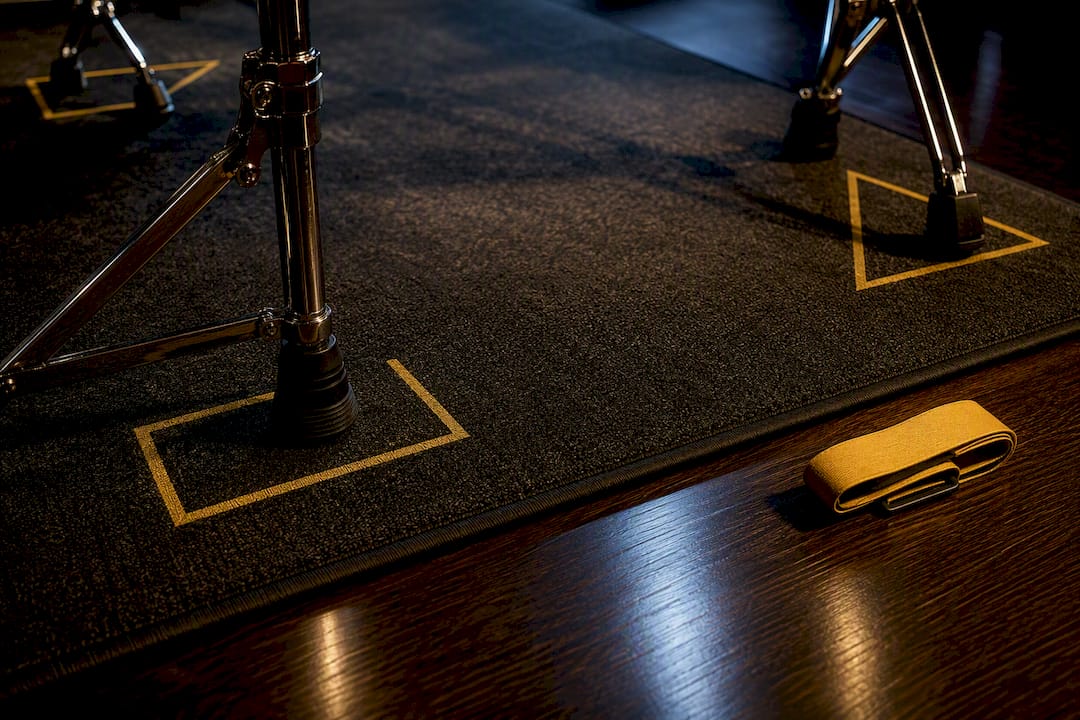
For hardware protection beyond the rug, rubber feet caps on hi-hat and cymbal stand legs prevent the kind of floor gouging that gets drummers banned from certain venues. Carpeted stages need less protection than tile or hardwood, but a rug still keeps spurs from sinking in and shifting mid-set.
Fold the rug the same way every time and store it in its own bag rather than loose in the hardware case; a rug that arrives creased and rolled the wrong way never lies flat under a kit, which defeats the point of marking it in the first place.
Maintenance Kit and Emergency Parts
The maintenance kit and the emergency pouch overlap but aren’t identical. The maintenance kit lives at home and includes lubricant, a small screwdriver set, spare felts, and cleaning cloths for regular upkeep between gigs. The emergency pouch travels with you and holds only what fixes a failure on the spot.
Keep both stocked separately so you’re never raiding your home maintenance kit the night before a show and forgetting to restock it. A simple rule works well: anything you’d need to fix a problem in under two minutes goes in the travel pouch; anything for a slower, at-home job stays in the maintenance kit.
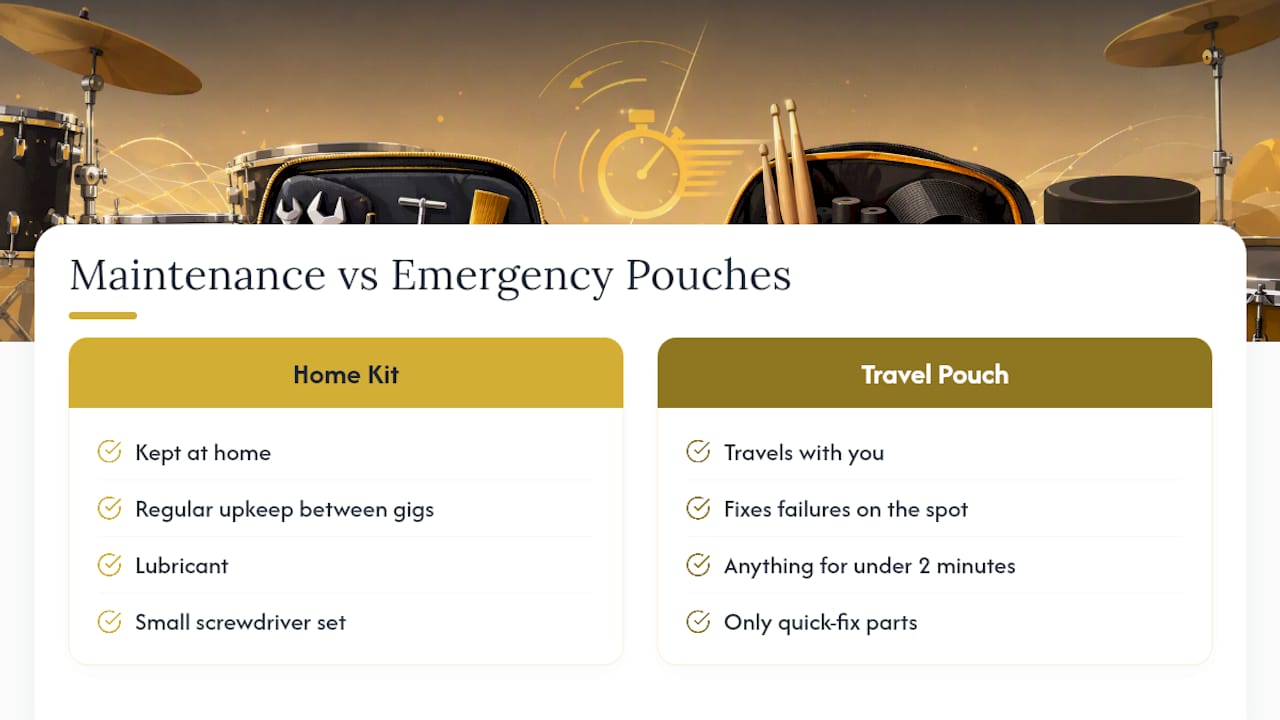
Restock immediately after using a part from the travel pouch, not “eventually.” The gap between “I’ll replace that felt next week” and the next gig where you need it is exactly how emergency kits become useless right when you need them most.
Practice Pads and Headphones or In-Ear Monitors
A practice pad solves a problem that has nothing to do with your kit: where do you build technique when you can’t make noise? Quality pads paired with headphones or in-ear monitors let you drill rudiments in a hotel room, backstage, or a shared apartment without a single complaint from a neighbor.
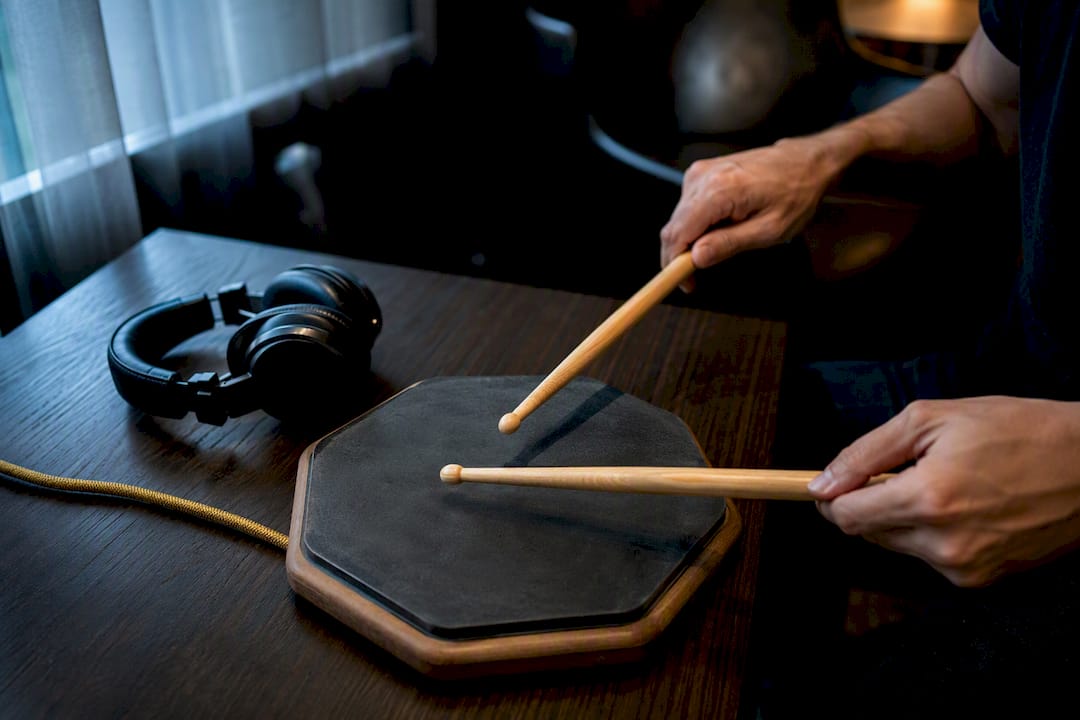
Pad surfaces vary more than beginners expect. A hard rubber pad gives realistic rebound for stick control work, while a softer gum rubber surface is quieter but feels mushier under fast single strokes. If your main goal is speed and rebound accuracy, lean toward firmer pads even though they’re slightly louder.
Headphones matter more than most drummers assume. Closed-back over-ear headphones isolate outside noise and keep your own volume down, which protects your hearing during long practice sessions the same way earplugs do on stage. In-ear monitors serve a different purpose entirely, they’re for live mix feeds, not silent practice, so don’t expect them to replace headphones for pad work.
Pair a pad with a metronome from day one. Technique built without a time reference tends to drift, and drummers who practice exclusively on a pad without a click often discover the gap only once they’re back behind a full kit.
Cymbal Felts and Sleeves: Small Parts, Big Protection
Felts and sleeves look like an afterthought until one goes missing and your cymbal starts clanking against the metal stand every time you hit it. Beyond the noise, that metal-on-metal contact can crack a cymbal’s bell over time, which is an expensive lesson to learn the hard way.
Cymbal felts and sleeves belong in every emergency pouch because they wear out or go missing more often than almost any other small part. Felts compress and flatten with use, which changes how a cymbal resonates, a fresh felt can noticeably open up a crash’s sustain compared to one that’s been squashed flat for two years.
Sleeves protect the bell hole from the stand rod itself. A missing or split sleeve lets the cymbal rattle against bare metal, and over hundreds of gigs that contact point can develop a keyhole crack radiating outward. Carry several spare felts and sleeves; they’re inexpensive and take up very little space.
Some drummers swap standard felts for slightly thicker ones on crashes to reduce choke and encourage more open sustain, a nearly free tonal adjustment that most players never think to try.
Drum Throne Selection and Comfort
The throne is the accessory drummers most consistently underbudget. A wobbly, thin seat undermines everything else on this list, because poor posture from a bad throne causes fatigue and tension that no amount of gear organization fixes.
Look for a throne with a firm foam core rather than overly soft padding; soft foam feels comfortable for the first ten minutes and then compresses unevenly, tilting your hips and throwing off your pedal technique over a long set. Height range matters too. Your thighs should slope slightly downward from hip to knee, not flat or angled upward, which is the seating position most drum educators recommend for hip mobility and pedal control.
Round tops suit players who shift position frequently; saddle-style seats suit players who sit in one spot and want more stability for double bass or fast footwork. Neither is objectively better, it depends entirely on how much you move on the seat during a set.
A quick-release height adjustment saves real time between soundcheck and set, especially on shared bills where you’re adjusting the throne for your own height after someone else used the kit.
Lubricants and Cleaning Supplies for Drum Hardware
Hardware fails slowly, through friction and corrosion, long before it fails suddenly on stage. A light machine oil or dedicated hardware lubricant on pedal cams, hinges, and hi-hat rods keeps action smooth and prevents the squeaking that a room mic will absolutely pick up.
Avoid heavy grease on moving metal parts exposed to dust, it attracts grit that turns into a gritty paste over time and actually increases friction rather than reducing it. A dry lubricant or light oil applied sparingly works better for pedal springs and hinge points that see a lot of movement.
For finish and shells, a microfiber cloth and a mild, non-abrasive cleaner keep hardware chrome from developing pitting corrosion, especially important for drummers who play sweaty outdoor gigs or humid club basements regularly. Wipe down stands and lugs after any gig where you noticed visible sweat or condensation on the hardware.
Keep a small bottle of lubricant and a cloth in your maintenance kit at home, not your travel pouch, since this is preventive work best done between gigs rather than urgently backstage.
Moongel and Damping Gels for Overtone Control
Some drums ring longer than the music calls for, especially on brighter-tuned snares and toms in live rooms with hard walls. Damping gels solve this without permanently altering the head or requiring a retune.
A small pad of gel placed near the rim absorbs excess overtone while leaving the fundamental pitch and most of the resonance intact, a more surgical fix than taping a full sheet of gaffer tape across the head, which mutes far more than it should. Start with one small piece per drum and add more only if ringing persists, since over-damping flattens tone and kills sustain you probably want to keep.
Gel loses stickiness over repeated use and picks up dust, so replace pieces once they stop adhering cleanly rather than forcing a worn piece back onto the head. Keep a spare sheet in your maintenance kit, they’re cheap and small enough that there’s no reason to run out mid-tour.
Damping needs change by room. A dead, carpeted club needs far less gel than a live room with hardwood floors and bare walls, so treat this as a per-gig adjustment rather than a permanent setup.
Drum Mutes and Practice Silencers
For apartment living or late-night practice, mutes and silencer pads drop your kit’s volume dramatically while preserving stick feel and rebound. Unlike a practice pad setup, mutes sit directly on your actual drums and cymbals, letting you rehearse full arrangements at a fraction of the volume.
Rubber mutes for drum heads cut volume the most but change rebound noticeably, useful for late-night runs through a setlist where feel matters less than not disturbing neighbors. Mesh-style silencers preserve more natural rebound while still cutting volume substantially, a better choice if you’re working on technique rather than just running through songs quietly.
Cymbal mutes, thin rubber discs that sit over the bow and edge, matter just as much as drum mutes since unmuted cymbals are often the loudest part of a quiet-practice setup. Keep a full mute set, one per drum and cymbal, in a separate bag from your gig gear so you’re never tempted to grab gig felts for a home practice session and forget to put them back.
The Gear That Actually Prevents Bad Gigs
Every drummer eventually learns the hard way that expensive gear doesn’t prevent bad shows, missing small parts does. The most common gig disasters I’ve seen described come down to a stripped rod, a lost clutch felt, or a set of sticks left in a car, never a cymbal that wasn’t premium enough.
Conventional gear lists lean heavily toward what’s exciting to buy: new cymbals, flashy pedals, boutique snares. That’s backward from a reliability standpoint. The 80/20 heuristic holds up under scrutiny: a small set of unglamorous tools, a key, a multi-tool, a handful of spare parts, solves most stage problems that actually happen.
If you’re building your kit from scratch, prioritize in this order: mechanical reliability first (key, spares, rods), hearing protection second, practice tools third, tonal refinements last. Drummers routinely reverse this, buying damping gels before they own a spare snare head. Fix the boring stuff first. The exciting upgrades matter far less when a stripped rod takes you off stage entirely.
— Will
Where to Find These Essentials
There are plenty of ways to piece together a kit like this, a hardware store multi-tool here, a generic earplug set there, but consistency across items is what actually makes an emergency pouch reliable under pressure. Several retailers stock curated accessory lines alongside exclusive London Drumstick Co. and Alchemist Cymbals ranges, so customers don’t need to guess whether a cheap tension rod fits specific lugs or whether a felt is the right thickness for a cymbal stack.

Browse the Temple of Sound shop for stick bags, spare parts, damping gels, and hardware accessories sized to match the gear you already own. If you’re outfitting a full emergency pouch for the first time, start with drum keys, spare tension rods, and a pair of lossless earplugs, then build outward from there. Check the site for current stock on custom stick options if you want sticks matched to your specific weight and grip preferences.
Sources
- Essential drum accessories
- Emergency kit for drums: 13 things every drummer should carry along
- Best drum accessories