21 September 2026
Lab Proven: Cymbal Bell Size Effects on 1–3 kHz Overtones for Drummers
Lab Proven: Cymbal Bell Size Effects on 1–3 kHz Overtones for Drummers
Bell size pushes a cymbal’s energy into a specific frequency band, and that shift drives almost everything you hear. Larger bells concentrate radiation around 1,000 to 3,000 Hz, producing more overtones, a brighter attack, stronger projection, and longer sustain. Smaller bells push energy toward 4,000 to 5,000 Hz instead, giving you a tighter, drier sound with clearer stick definition and a faster decay. Weight and profile modify both patterns, but bell size alone accounts for a lot of what separates one cymbal’s voice from another.
TL;DR:
- Larger bells produce more overtones and brighter attack by radiating efficiently between 1,000 and 3,000 Hz, making them suitable for loud, projecting settings.
- Smaller bells radiate energy at higher frequencies around 4,000 to 5,000 Hz, resulting in a tighter, drier sound with clearer stick definition.
- Weight and profile significantly influence cymbal tone, with heavier and higher-profile cymbals responding more slowly but sustaining longer, regardless of bell size.
- For jazz or studio work requiring quick decay and clarity, choose small bells; for rock or metal where projection and sustain matter, opt for large bells.
- Audition cymbals with consistent sticks, in the actual playing environment, focusing on decay and harmonic complexity rather than initial volume alone.
Table of Contents
- How Bell Size Changes Frequency Content and Overtones
- Why Bell Size Drives Volume, Projection, and Sustain
- Does Weight or Profile Matter More Than Bell Size?
- Small vs. Large Bells: Matching the Cymbal to the Music
- How to Choose the Right Bell Size: A Practical Checklist
- Getting It Right: Auditioning Notes From Temple of Sound
- Lab Data Explains the Pattern, Your Ears Make the Call
- Sources
- FAQ
How Bell Size Changes Frequency Content and Overtones
A cymbal’s bell is not just a mounting dome. It is a distinct vibrating structure with its own modal behavior, and its size determines which frequencies it radiates efficiently.
A modal-analysis study on cymbal bell size measured this directly using finite-element methods. Cymbals with larger bells showed strong radiation efficiency peaks between roughly 1,000 and 3,000 Hz. Cymbals with smaller bells radiated more efficiently at higher frequencies, generally 4,000 to 5,000 Hz. Related modal-analysis figures confirm the same banding: the underlying vibration frequencies barely change with bell size, but which modes radiate loudly does change substantially.
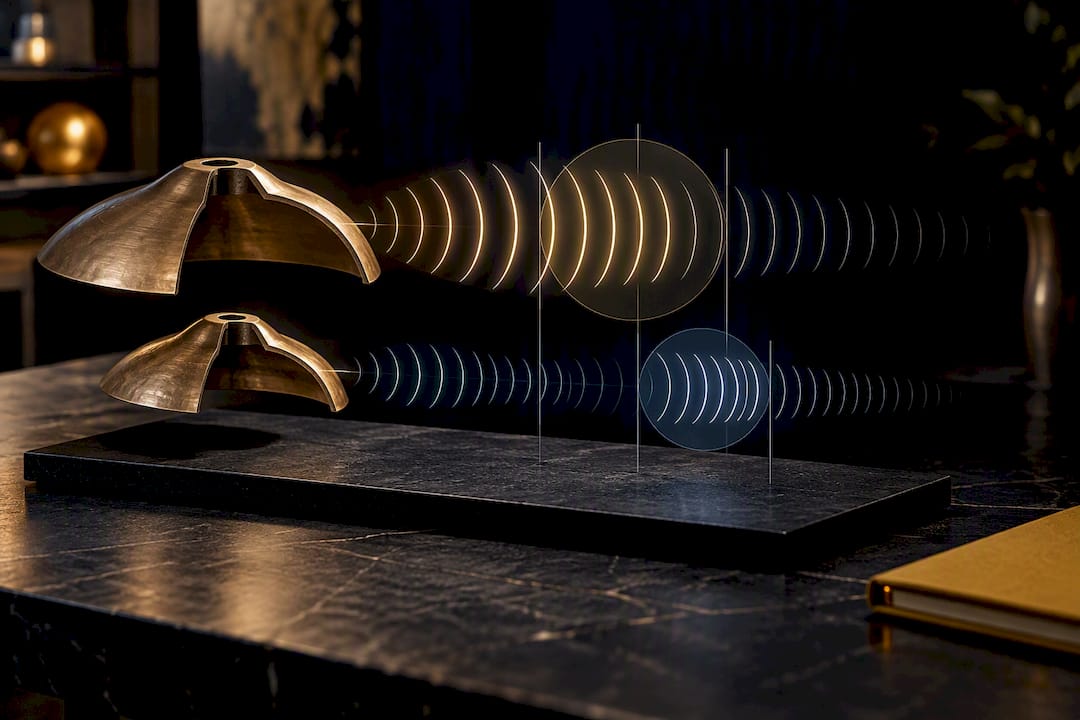
The physical reason traces back to nodal geometry. Larger bells deform more broadly during a strike, favoring modes with fewer nodal diameters, which radiate efficiently at lower and midrange frequencies. Smaller bells settle into higher-order modes that push efficient radiation upward in pitch. Sabian’s own cymbal-anatomy guidance echoes this in plain terms: bell size affects brightness and overtone content, and a larger bell relative to the cymbal’s diameter tends to add more overtone complexity.
What to listen for when auditioning:
- A shift toward “shimmer” and harmonic complexity as bell size increases
- A drier, more percussive attack from smaller bells
- Less separation between the bell’s ping and the bow’s wash on larger-bell cymbals
Why Bell Size Drives Volume, Projection, and Sustain
More bell mass and surface area means more air gets moved per strike, which raises both the loudness ceiling and how long that sound holds up in a room. That is not a subjective impression. It is a direct consequence of how much material is vibrating and radiating energy at once.
Paiste’s cymbal anatomy page notes that larger cymbals sustain longer, and larger bells specifically tend to sound livelier, functioning almost as a second, higher-pitched playing surface layered on top of the main bow.
In practice, this splits along genre lines:
- Rock and metal drummers often want the increased projection and sustain a larger bell provides, since the cymbal has to cut through distorted guitars and a full kit at stage volume.
- Jazz and studio players frequently prefer the opposite: a smaller bell that decays fast enough to avoid smearing quick passages or bleeding into close mics.
- Fusion and function-band drummers often land in between, picking a mid-sized bell that projects without overwhelming a mix.
The tradeoff is straightforward. What gives you presence on a loud stage can bury a quiet ballad in unwanted wash.
Does Weight or Profile Matter More Than Bell Size?
Bell size never acts alone. Weight and profile bend how any given bell size actually sounds, and ignoring that is the most common mistake drummers make when shopping by spec sheet alone.
Practitioner guidance from Nick Petrella’s cymbal-selection research lays out the standard generalizations clearly:
- Light cymbals respond quickly, decay fast, and lean darker in overall character.
- Heavy cymbals respond more slowly, sustain longer, and lean brighter.
- Higher profile (a taller, more domed bow) raises the fundamental pitch.
- Bell size layers overtone content and projection on top of whatever the weight and profile already establish.
That means a small bell on a heavy, high-profile cymbal can still sound surprisingly loud and complex, while the same small bell on a thin, flat cymbal stays closer to a classic dry, controlled voice. The variables compound rather than cancel. If you want to isolate what the bell itself is doing, compare two cymbals with similar weight and profile but different bell sizes, and pay attention to the hi-hat weight guide if you are trying to separate mass effects from bell effects on your own kit. Listen specifically for overtone density and decay length rather than initial volume, since weight tends to dominate the attack while bell size shapes what happens after it.
Small vs. Large Bells: Matching the Cymbal to the Music
Small bells suit jazz combos, studio sessions, and any low-volume context where stick definition needs to stay audible over wash. A small bell also rewards accurate striking, since there is less bell surface to catch, and some drummers use one deliberately to tame an otherwise bright cymbal.
Large bells suit live rock, metal, and any setting demanding cut-through power. They forgive imprecise strikes better because there’s simply more target, but that same forgiveness can tip into overpowering a quiet mix if you’re not careful with dynamics.
- Small bell: jazz ride work, brush-adjacent playing, close-mic’d studio takes
- Large bell: arena and club rock, metal crash-rides, any spot where the cymbal needs to be heard over a full band
- Flat rides with no bell at all sit at the extreme dry end, offering maximum stick definition with essentially no bell resonance to color the note
- Flat rides with no bell at all sit at the extreme dry end, offering maximum stick definition with essentially no bell resonance to color the note
Pro Tip: If your ride sounds muddy live but great in a quiet room, the bell size might be fine. The problem is more likely bell size fighting with a low profile or a low-quality PA mic placement.
How to Choose the Right Bell Size: A Practical Checklist
Picking a bell size gets easier once you audition with intent instead of guessing from a spec sheet. Run through this checklist every time you’re comparing cymbals in person:
- Define the role first. Is this a primary ride, a crash-ride, or an accent cymbal?
- Use the same sticks for every comparison. Stick tip material and weight change what you hear as much as the cymbal does, so keep that variable fixed.
- Test at the volume and in the room type you’ll actually play in, not just the quiet shop corner.
- Strike each cymbal with matched force and compare projection against wash, not just loudness.
- Listen past the first hit. Decay time and harmonic complexity show up one to two seconds after the strike, not in the initial attack.
The decision flow is simple once you’ve done that legwork. If you need projection and cut, favor a larger bell, ideally paired with more weight. If you need clarity and control, favor a smaller bell or a flatter profile. If you’re still unsure, start with a mid-sized bell on a standard 17 to 18 inch ride, then audition the extremes on either side once you know which direction you’re drifting.
| Musical role | Best-fit bell size | Why |
|---|---|---|
| Jazz or studio ride | Small | Fast decay, clean stick definition |
| Live rock or metal ride | Large | Strong projection, longer sustain |
| Splash or accent | Small | Quick, focused burst without excess ring |
| Function band, all-purpose | Medium | Balances cut and control |
For a deeper breakdown of diameter choices alongside bell size, the ride cymbal sizing guide and the splash cymbal sizing guide both walk through how these two variables interact on specific cymbal types.
Getting It Right: Auditioning Notes From Temple of Sound
Auditioning by ear beats trusting spec sheets alone, and that’s the whole premise behind the Alchemist Collection available through Temple of Sound. Handcrafted cymbals show more individual bell variation than mass-produced lines, which makes an in-person or in-hand comparison worth the extra step.
Pair your test with a consistent stick from the London Drumstick Company so you’re not accidentally comparing tip materials instead of bell sizes. If you want more context before you buy, the dark vs. bright cymbal guide and the cymbal pack selection guide both build directly on the bell-size principles covered here. Reach out to Temple of Sound directly if you want guidance matching a bell size to a specific kit or genre.
Lab Data Explains the Pattern, Your Ears Make the Call
Modal analysis tells you what a bell size tends to do on average. It doesn’t account for the specific alloy, hammering, or lathing on the cymbal in your hands. Trust the frequency bands as a starting point, then let repeated auditioning settle the final choice.
— Will
Sources
- Effect of bell size on sound characteristics of cymbals
- Natural frequencies and sound radiation efficiencies (modal-analysis data)
- Choosing Cymbals, Nick Petrella (Texas Bandmasters Research)
- Cymbals 101 - Sabian
- Cymbal anatomy - Paiste
FAQ
Why Doesn’t Lars Ulrich Use a Ride Cymbal?
Some drummers, including certain metal players, favor crash-heavy setups over a dedicated ride because the genre’s tempo and volume make a big, bright crash more useful for driving rhythm than a traditional ride’s ping and wash. This is a stylistic and technique choice rather than a rule tied to bell size specifically.
What Is the Best Ride Cymbal Size?
There’s no single best size. It depends on your role. Mid-sized rides generally balance cut and control, jazz players often prefer smaller rides for quicker decay, and rock or metal drummers lean toward larger rides for projection.
Which Cymbal Is the Loudest?
Larger, heavier cymbals with larger bells generally produce the highest volume ceiling because more vibrating mass radiates more sound pressure. Large-bell, heavy crash-rides tend to top the loudness scale among common cymbal types.
What Is the Best EQ for Ride Cymbals?
There’s no universal EQ setting since it depends on the specific cymbal’s bell size and weight, but a common starting point is a gentle boost around 4 to 5 kHz to bring out stick definition on smaller-bell rides, and a modest boost near 1 to 3 kHz to enhance overtone shimmer on larger-bell rides.