15 September 2026
4 Step Audition for Drummers: Matched Cymbal Set or Mix Brands?
4 Step Audition for Drummers: Matched Cymbal Set or Mix Brands?
Buy a matched cymbal set if you want guaranteed sonic cohesion and the best price per piece, especially as a beginner or backup kit. Mix brands and lines if you want a custom voice tailored to your playing style, and you’re willing to audition pieces individually. Beginners and gigging drummers on a budget usually do best with a pack; players chasing a specific sound for a genre or a studio role usually do better mixing.
TL;DR:
- Matched cymbal packs provide cohesive tone, better value, and quick setup, making them ideal for beginners, backups, or building a dedicated practice kit.
- Mixing cymbals from different brands or lines allows customization but requires careful audition, matching tonality, and adjustments to avoid clashing sounds.
- Testing cymbals in a fixed order—starting with hi-hats, then crashes, then rides—ensures accurate judgment of each piece’s contribution to the kit.
- Alloy, size, and weight largely determine a cymbal’s pitch, tone, and response, so matching these factors ensures seamless blending or desired contrast.
- Proper maintenance, storage, and cautious online shopping help preserve cymbal sound quality and avoid unintended tonal drift over time.
Table of Contents
- Why a Match Cymbal Set Makes Sense for Most Drummers
- When Mixing Brands or Lines Beats a Matched Set
- How Do You Audition and Match Cymbals Before Buying?
- How Do Alloy, Size, and Weight Affect Cymbal Matching?
- What Configuration Should You Start With? Practical Advice From Templeofsound
- Common Mistakes When Selecting Cymbals to Match or Mix
- Which Cymbals Benefit Most From Matching vs Mixing?
- How Do You Maintain a Match Cymbal Set’s Sound Over Time?
- Mixing as a Creative Choice, Not a Compromise
- Get a Curated Match Cymbal Set or Custom Advice From Templeofsound
- Sources
- FAQ
Why a Match Cymbal Set Makes Sense for Most Drummers
A matched cymbal set solves the hardest problem in cymbal shopping before you even open the box: it guarantees the hi-hats, crash, and ride were voiced to work together. The manufacturer already picked the alloy, weight, and profile combination that produces a cohesive family of tones, so you’re not gambling on whether a bright B8 crash will fight with a darker B20 ride.
Price is the other half of the equation. Buying a 14-inch hi-hat pair, a 16-inch crash, and a 20-inch ride separately almost always costs more than the same three pieces sold as a set, since manufacturers pass some of the manufacturing and packaging efficiency on to the buyer. Vendor listings for entry-level performance sets routinely bundle four or five pieces at a price that would barely cover two of them individually.
Time matters too. A gigging drummer replacing a stolen or cracked cymbal before Saturday’s show doesn’t have three weeks to audition twelve rides at a shop. A pack removes that decision fatigue entirely. That’s exactly why matched packs dominate the beginner and budget segment: entry-level brass and bronze packs are specifically built to give newer players a balanced, listenable kit without forcing them to learn cymbal terminology first.
But “matched” doesn’t mean flawless across every piece. Reviewers testing budget sets have repeatedly found that hi-hats are the component most likely to underperform relative to the crash and ride in the same box. A review of the Zultan Alaris series found strong crashes and a capable ride paired with hi-hats that lacked the same body and pitch consistency. The same pattern shows up with pricier packs: an Istanbul Mehmet IMC Bronze Natural box set delivered strong overall balance, but the ride bell fell short of the rest of the set.
Here’s when a matched pack is the smart default rather than a compromise:
- Building a dedicated practice kit where consistency matters more than character
- Assembling a backup or loaner set for teaching studios or rental gear
- Making a first real upgrade from stock cymbals on a tight budget
- Outfitting a second kit for a different venue or genre without a big spend
Pro Tip: Never assume every piece in a “matched” box is equally strong. Play each cymbal on its own before you decide the set is a keeper. If the hats disappoint but the crash and ride impress, you can often swap just the hats later without losing the cohesion you paid for.
When Mixing Brands or Lines Beats a Matched Set
Mixing exists for one reason: no single manufacturer’s lineup covers every sound a drummer needs. You might want a dark, trashy crash from one maker, glassy hi-hats from another, and a ride with a huge bell from a third. A matched pack forces a compromise across all three; mixing lets you optimize each piece for its job.
This is standard practice among experienced players. Community discussion on forums like Reddit’s drumming community shows drummers routinely combining brands, with the consensus landing on one rule: audition before you commit, don’t assume compatibility from spec sheets alone.
The risk is real, though. Cymbals from different alloys and manufacturing processes can clash in ways that are hard to predict from a product photo. A bright, cutting crash next to a warm, complex ride can sound disjointed on a recording even if each cymbal sounds great solo. Pitch relationships matter more than most players expect. If your hi-hats sit a full step below your ride’s fundamental pitch, the two will fight for the same frequency space instead of complementing each other.
A few practical strategies cut that risk down significantly:
- Match tonal family first. Decide whether you’re building a dark, trashy kit or a bright, cutting one, then choose every piece within that family regardless of brand.
- Mind the hat to ride pitch relationship. Play them back to back before buying; if they sound like they’re arguing, they probably will on stage too.
- Audition together whenever possible. A shop visit where you can play candidate pieces side by side beats guessing from online demos.
- Use dampening or positioning as a fix before buying new gear. Small adjustments (a slightly heavier hat top, different cymbal spacing) can resolve a clash more cheaply than replacing a cymbal outright.
That last point is underused. Drummer’s Review’s testing of mixed bronze sets found that minor setup changes often solve a perceived tonal clash that players initially blame on the cymbals themselves. Before you sell a cymbal that “doesn’t fit,” try dampening it or moving it on the stand.
Mixing rewards patience. It punishes drummers who buy based on a single YouTube demo and never play the pieces together in their own room.
How Do You Audition and Match Cymbals Before Buying?
Testing cymbals in the wrong order wastes time and skews your judgment. Play a splash first and every crash you hear afterward will sound duller than it is. Follow a fixed sequence and you’ll hear each piece for what it actually contributes to the kit.
- Start with the hi-hats. They’re the piece you’ll play more than any other, and their sound sets the tonal baseline for everything you audition next.
- Move to the crash or crashes. Listen for how quickly the attack blooms and how long the wash lingers after the initial hit.
- Test the ride. This is the cymbal doing the most work in most styles, so give it the most time. Play it at low volume for jazz style timekeeping and at full stick for rock patterns.
- Finish with effects cymbals. Splashes and Chinas are accent pieces. Testing them last keeps your ear calibrated for how they’ll sit against the rest of the kit rather than judging them in isolation.
At each stage, listen for five specific qualities: attack (how sharp the initial hit sounds), stick definition (can you hear the tip clearly through the wash), bell clarity if you play rim patterns, decay length, and the pitch relationship to the piece you just tested before it. A ride with a large, clearly defined bell gives developing drummers an easier reference point for dynamics, which is one reason a 20 inch ride is commonly included in beginner packs to provide a larger sweet spot and clear bell definition.
Room acoustics distort your perception more than most players realize. A cymbal that sounds thin in a heavily carpeted practice room can sound completely different on a hard-floored stage. If you’re testing for a recording context, ask the shop to mic the cymbal the way you’d track it at home, or bring a portable recorder and listen back later rather than trusting your live ear in an unfamiliar room. A resource like Sound Studio’s mixing guidance is worth a look if you’re trying to judge how a cymbal will actually translate once it’s recorded and processed, since a raw in-room impression and a mixed track can sound like two different instruments.
Buying online removes the ability to play before you commit, but it doesn’t remove your ability to judge quality. Watch video demos recorded with a shotgun mic close to the cymbal rather than a phone camera across the room. Check the seller’s return policy before you buy anything you haven’t played, since a legitimate retailer will let you send back a cymbal that doesn’t match your expectations once it arrives. Buy from sellers with a track record rather than marketplace listings with no reviews, and if you can get a friend to do a blind listening test with you, do it. Your eyes and brand loyalty bias your ears more than you’d like to admit.
Pro Tip: When auditioning rides for a jazz or brush context, play them at the volume you’ll actually use live. A ride that sounds glorious under a hard stick in a shop can turn thin and clattery the moment you back off to a whisper.
How Do Alloy, Size, and Weight Affect Cymbal Matching?
Three physical variables decide whether cymbals blend or clash: the alloy, the diameter, and the weight or profile. Understanding them turns cymbal shopping from guesswork into an informed decision.
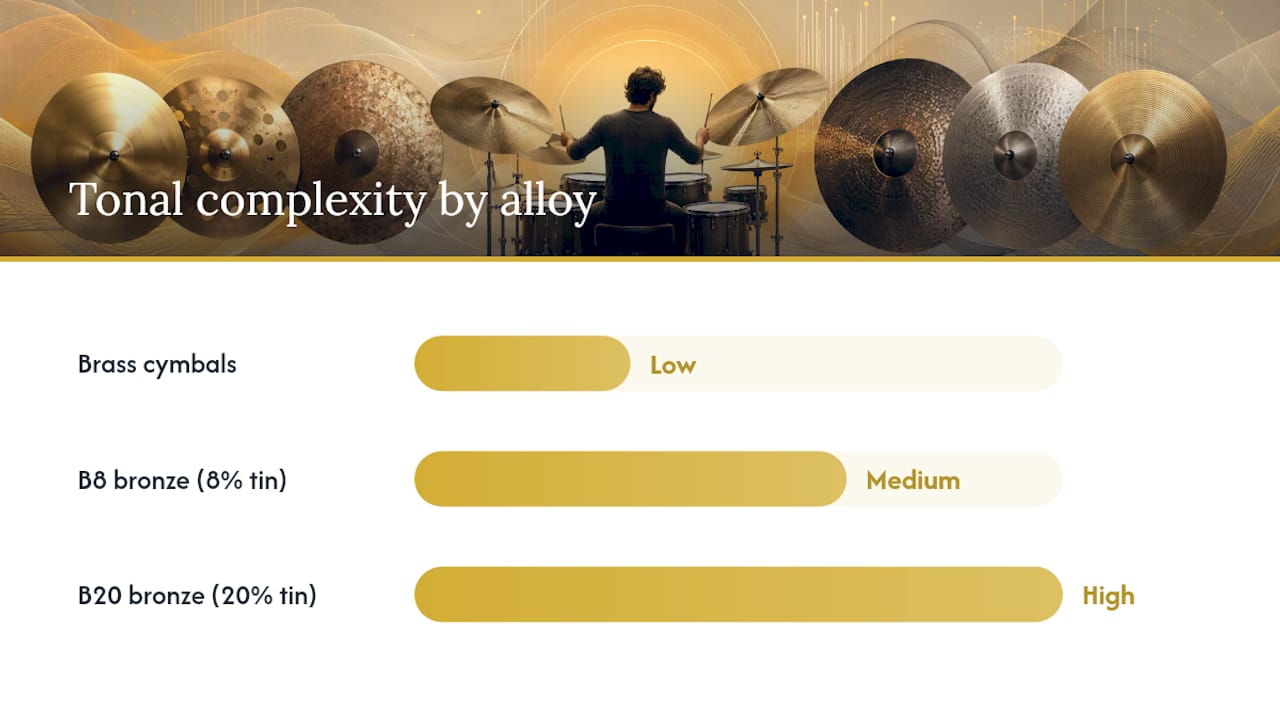
Alloy sets the baseline character. Brass cymbals, common in entry-level packs, tend toward a simpler, brighter, less complex overtone structure. B8 bronze (8% tin) sits a step up in complexity and is common in mid-tier gear. B20 bronze (20% tin), used in most professional lines, produces the richest, most layered overtones and the longest, most musical decay. This is why experienced drummers gravitate toward B20 lines once they’ve outgrown a starter kit. Mixing alloys across your kit isn’t automatically wrong, but it does mean the tonal complexity will vary noticeably from piece to piece, which some drummers want and others find distracting.
Size determines pitch and how a cymbal sits in the frequency spectrum relative to its neighbors. Standard crash sizes (16, 18 inch) leave gaps that some drummers fill with odd sizes. A 17 inch or 19 inch crash isn’t a novelty measurement; it’s a deliberate design choice that fills the tonal space between two more common sizes so your crashes don’t all occupy the same pitch range.
Weight and profile control attack, sustain, and how the cymbal responds to a hard hit. A few rules of thumb:
- Thin cymbals respond fast, wash out quickly, and crash easily even under a lighter touch, but they can lack projection in a loud band mix.
- Medium weight cymbals balance stick definition with enough body to cut through a full band, making them the safest default for mixed genre playing.
- Heavy cymbals deliver strong projection and a controlled, focused sound, but they need real force to open up, which makes them a poor fit for lighter jazz or brush playing.
The practical pairing rule: keep your kit within one tonal family (all leaning dark or all leaning bright), avoid combining an extremely thin cymbal with an extremely heavy one unless you specifically want that contrast, and lean toward similar alloys when you want the most seamless blend. A heavier drum kit with dense shells pairs naturally with brighter cymbals to cut through the low end, while lighter, more resonant shells often sound best with darker, more complex cymbals that won’t overwhelm the drum tone.
What Configuration Should You Start With? Practical Advice From Templeofsound
As the UK’s distributor for Alchemist Cymbals and the London Drumstick Co., Templeofsound spends a lot of time fielding the same question from drummers at every skill level: what do I actually buy first? The honest answer depends on what’s currently holding your kit back, not on what’s trending in a gear forum.
If your current hi-hats sound thin or choke when you play a tight pattern, they’re usually the smartest first upgrade. You touch them more than any other cymbal, so an improvement there changes how your whole kit feels to play. If your crash sounds harsh or your ride washes out instead of giving you clean stick definition, that’s your priority instead. For most rock and pop players, upgrading the ride first pays off more than a new crash, because the ride carries the groove and gets exposed on every song.
If you’re assembling a full kit from scratch or replacing a damaged set before a tour, a matched pack gets you a cohesive sound fastest, and you can swap individual pieces later as your ear develops.
Before you buy anything, a quick checklist helps: identify which single cymbal is actually limiting your sound, decide whether you’re chasing a dark or bright tonal family, and set a budget that lets you buy one great piece rather than three mediocre ones. If you’re not sure where to start, reaching out to a specialty distributor might help. Matching cymbals by ear over email or a call is the kind of practical advice a specialty distributor can offer that a big box retailer usually can’t.
Common Mistakes When Selecting Cymbals to Match or Mix
The most common mistake is buying based on a video demo alone. Compression and phone microphones flatten the differences between cymbals, so two rides that sound nearly identical online can feel completely different under your own sticks.
The second mistake is ignoring the hi-hats. Drummers spend most of their audition time on crashes and rides because they’re the flashiest pieces to demo, then settle for whatever hats came in the box. Since hats get played more than anything else, that’s backward.
A third mistake is assuming louder or bigger automatically means better. A heavy 20 inch crash in a small jazz combo will bury the rest of the band, while a big ride in a metal context might never cut through distorted guitars.
Finally, drummers often skip testing pieces together and only audition them solo. A cymbal can sound fantastic alone and still clash badly with your existing kit once you play them side by side. Always test new pieces against what you already own, not in isolation, before finalizing a purchase.
Which Cymbals Benefit Most From Matching vs Mixing?
Hi-hats benefit the most from staying matched, whether that means keeping the factory pair together or buying top and bottom from the same line if you replace one half. The two hi-hat cymbals interact directly with each other on every closed stroke, so pitch and weight consistency between top and bottom matters more here than anywhere else in the kit.
Crashes are the safest cymbals to mix. Since each crash is typically played on its own rather than in combination with another cymbal, a mismatched pair of crashes rarely causes the clashing overtone problems that plague hi-hats or ride and crash combinations played together.
The ride sits in the middle. It needs to relate tonally to your crashes since you’ll often move between them mid pattern, but it’s also the cymbal most drummers customize independently because ride preference is so personal, from bell size to stick definition to wash character. If you’re only going to carefully match one non-hi-hat pairing, match your ride’s pitch to your most-used crash rather than worrying about the rest of the kit.
How Do You Maintain a Match Cymbal Set’s Sound Over Time?
A matched set stays matched only if you take care of all the pieces equally. Uneven wear, buildup, or damage on one cymbal will drift its tone away from the rest of the set faster than you’d expect.
Clean cymbals with a product designed for their finish, not an all-purpose metal polish, since aggressive cleaners can strip the patina that gives some bronze cymbals their character. Wipe down sweat and skin oils after every session; left alone, they accelerate tarnishing unevenly across a set.
Store cymbals upright in padded bags or cases rather than stacked flat, since stacking cymbals directly against each other risks micro scratches and, over time, warping. Check your sleeves and felts regularly. Worn felts let a cymbal contact the stand directly, which chokes its sustain and throws off the tonal balance you paid for in the first place.
Inspect for hairline cracks near the bell or edge, especially after a hard-hitting gig. A cracked cymbal doesn’t just sound bad on its own; it changes the perceived balance of the whole set once it’s the odd one out. Our guide to cymbal care and cleaning covers product recommendations and storage specifics in more depth.
Mixing as a Creative Choice, Not a Compromise
Some of the most interesting kit sounds I’ve come across started as accidents. A drummer grabs a mismatched crash because it’s what’s on hand for a session, and it ends up defining the track’s character better than anything planned in advance. Mixing isn’t a fallback for drummers who couldn’t afford a matched set. It’s a legitimate way to build a voice nobody else has.
The discipline that makes it work is documentation. Record your test sessions, note which combinations you tried, and track what you changed when something clashed. Memory is unreliable after the fifth cymbal you’ve played that afternoon. Experiment freely, but write down what you learn before you forget it.
— Will
Get a Curated Match Cymbal Set or Custom Advice From Templeofsound
A specialty distributor can help avoid guessing your way through cymbal shopping alone, curating packs that are tested for tonal cohesion, not just bundled for a lower price tag.

Browse curated cymbal packs if you want guaranteed cohesion without the audition process, or reach out for a second opinion before you buy when mixing lines. Some customers may get access to trade pricing and loyalty rewards on future purchases, and support for specific pairings if building a custom voice rather than buying off the shelf. If you’re weighing a full pack against building piece by piece, our guide to choosing a cymbal pack is a useful next stop, and if you want to understand how crash and ride roles differ before you commit to either, read our crash versus ride breakdown. Visit Templeofsound to browse current stock and get in touch with our team for personalized recommendations.
Sources
- Best cymbals | MusicRadar
- Istanbul Mehmet IMC Bronze Natural cymbals box set – Drummer’s Review
- Sabian SBR Performance Cymbal Set review – SonicMetric
FAQ
What Is the Best Cymbal Set?
There’s no universal best set. Beginners generally get the most value from matched brass or entry bronze packs, while experienced players tend to prefer professional B20 bronze lines for their richer overtones.
What Is a Pair of Cymbals Called?
A pair of cymbals played together with a foot pedal is called hi-hats. When referring to two hand-held crash or clash cymbals struck together, drummers usually just call them “crash cymbals” or, in orchestral contexts, “clash cymbals.”
Is Sabian or Zildjian Better?
Neither brand is objectively better. Both make well-regarded cymbals across every price tier, and the right choice depends on whether you prefer a given line’s tonal character, which you can only judge by auditioning specific models rather than the brand name alone.
What Is the Best Cymbal Set for Beginners?
Entry-level performance packs with matched hi-hats, a crash, and a large ride tend to work best for beginners, since a larger ride bell gives new players an easier reference for dynamics and timekeeping. Templeofsound can point you toward curated starter packs if you’re unsure where to begin.
Should I Buy a Cymbal Pack or Build My Own Set?
Buy a pack if you want guaranteed cohesion, faster setup, and better value per piece. Build your own set if you already know your tonal preferences and want a ride, crash, or hi-hats optimized individually rather than as a bundle.